How to read the Bible with ADHD: what actually helps
How to read the Bible with ADHD: a few minutes a day, short books timed to the minute, audio alongside the text, and a plan where missed days never pile up.

The short answer
Reading the Bible with ADHD usually goes better when the reading is small, varied and forgiving. Set the daily amount in minutes rather than chapters, since a chapter can take a few seconds or ten minutes, and start with short, fast-moving books like Mark (about an hour in all) or Jonah (five minutes). Listen while you read, keep a pen in hand, keep a record you can watch fill up, and use a plan where a missed day simply passes instead of piling up.
In this guide
- Why Bible reading can feel harder with ADHD
- Make the portion small, and set it in minutes
- Start with short, fast-moving books
- Ways to focus while reading the Bible
- A Bible reading plan for ADHD that doesn’t pile up
- Make your progress visible
- How to study the Bible with ADHD
- When it still isn’t working
- Questions people ask
- Sources
Many Christians with ADHD know the pattern: a reading plan started with real energy, a strong first week, a few missed days, and then a list of unread chapters that is easier to avoid than to face. That pattern says more about how Bible reading is usually set up than about how much the Bible matters to you. What follows are practical ways to read the Bible with ADHD by changing the setup: the size of the daily portion, the books you start with, how you take the text in, and what your plan does after a missed day.
- 2.7 minan average chapter, read silently
- 5 minthe whole Book of Jonah
- 9 minPhilippians, start to finish
- 1 hourall 16 chapters of Mark
Why Bible reading can feel harder with ADHD
The usual way of reading the Bible asks for things many people with ADHD find hard: sitting with dense text for a long stretch, keeping the same routine every day, and coming back after a gap to something that now feels overdue. None of that is a verdict on your faith. It describes a format, and a format can be changed.
You are in large company. The CDC estimates that 15.5 million American adults, about 6 percent, had a current ADHD diagnosis in 2023, and that more than half of them were diagnosed at 18 or older. So a good many readers are working out what helps as adults, with reading habits they formed before they knew.
Some parts of the Bible are slow going for anyone. Genealogies fill the first nine chapters of 1 Chronicles before the story picks up with Saul’s death in chapter 10. Numbers 7 describes the same offering twelve times, once for each tribe’s leader, in about 1,900 words: eight minutes of reading, most of it nearly identical lines. Knowing such stretches are coming, and that you can read them quickly, takes some of the weight off.
Reading habits, not treatment
This guide is about how to set up Bible reading, not about ADHD itself. Nothing here is medical advice. Questions about diagnosis, treatment or medication belong with a doctor or another clinician who knows you.
Make the portion small, and set it in minutes
A daily amount set in minutes, such as five or ten, is steadier than a number of chapters, because chapters vary enormously in length. Psalm 117 is two verses and 24 words in the World English Bible, over in a few seconds. Psalm 119 is 176 verses and about 2,300 words: ten minutes of silent reading, and nearly a hundred times as long. “Three chapters a day” can mean about a minute (Psalms 129 to 131) or eighteen minutes (1 Kings 6 to 8).
Most chapters are short, though. By our count, 771 of the 1,189 chapters in the Protestant Bible, nearly two thirds, take three minutes or less to read silently at the average adult pace, and 1,121 take five minutes or less. Five minutes is usually one or two chapters, and ten minutes is usually three or four.
Pick an amount you could keep on a scattered day, not on your best one. At a relaxed pace of about 3.3 minutes a chapter, five minutes a day takes you through the whole Bible in a little over two years, and ten in a little over one. Our guide to how many minutes a day to read the Bible works through each option.
Keep a smaller fallback for the hardest days as well. One psalm counts, and by our count 135 of the 150 psalms take two minutes or less.
Start with short, fast-moving books
Short books give you a finished thing quickly, and a finished book is a better reason to come back than a bookmark halfway through Jeremiah. Each of these takes a single sitting, or a few days of short ones:
| Book | Chapters | Reading time | What it’s known for |
|---|---|---|---|
| Ruth | 4 | 10 minutes | A widow's loyalty, four chapters long |
| Jonah | 4 | 5 minutes | The prophet who ran the other way |
| Mark | 16 | 1 hour | The fastest gospel — everything happens 'immediately' |
| Philippians | 4 | 9 minutes | A joyful letter written from prison |
| Colossians | 4 | 8 minutes | Christ over everything |
| Philemon | 1 | 2 minutes | One chapter about one runaway slave |
| James | 5 | 9 minutes | Blunt, practical, five chapters |
| 1 John | 5 | 10 minutes | “God is love” |
| Jude | 1 | 3 minutes | One fierce chapter |
Words are our own count of the World English Bible, a public-domain modern translation. Reading time is silent reading at 238 words a minute, the adult average.
Mark is the natural first Gospel for a restless reader. It is the shortest of the four, 16 chapters and about an hour in all, and it moves fast: by our count the World English Bible uses the word “immediately” 42 times in Mark, against 19 times in Matthew’s 28 chapters. Our guide to which Gospel to read first compares all four.
Jonah takes five minutes and has a storm, a huge fish and an argument with God in it. Ruth is a complete story in four chapters, about ten minutes. Philippians and James take about nine minutes each, and James in particular comes in short, plain paragraphs. After a few of these, the story-heavy longer books carry a reader along from scene to scene: Genesis, 1 Samuel and Acts.
You do not have to go in order at all. A 2020 list of tips in The Alabama Baptist for Bible study with learning disorders like ADHD includes studying topics of special interest. If a person (David, Peter) or a question you keep coming back to pulls at you, following it through the Bible is a fair way to read.
Ways to focus while reading the Bible
Many of the practical tips for Bible reading with ADHD add a second channel to it: hearing the words, writing about them, or keeping your hands busy. The Alabama Baptist’s list includes Scripture spoken through an app, a mix of reading, listening, journaling and writing out verses, color-coding, and a discreet fidget.
Listen while you read
Play an audio Bible and follow the same passage in print. The voice sets the pace, which makes it harder to drift three verses ahead while thinking about something else. Reading aloud yourself does something similar, and it is slower: a review of reading-rate studies puts adults at about 183 words a minute aloud, against 238 for silent reading of nonfiction. That slower pace is part of the point.
Listening on its own counts too. A chapter heard on a walk or a commute is a chapter taken in, and the last book of the Bible opens with a blessing on the hearers as well as the reader:
Blessed is he who reads and those who hear the words of the prophecy, and keep the things that are written in it, for the time is near.
Revelation 1:3, World English Bible
Give your hands something to do
- A pen. Underline, number the steps of an argument, put a question mark where you lose the thread.
- Colors. One color for promises, another for commands, a third for names. The point is a reason to look for something, not a perfect system.
- One line a chapter. A sentence about what happened or what struck you, in a notebook kept with your Bible.
- Something to fidget with. A stress ball or a fidget toy, used quietly.
- Writing a verse out. Copying a verse by hand is slow on purpose.
Keep the phone quiet, or out of the room
If you read on a phone, turn on Do Not Disturb or a Focus for the few minutes of the reading, since a single notification can end the session. A paper Bible kept in the same spot with a pen avoids the problem altogether, and the same Alabama Baptist list suggests a fixed place for books and study things.
A Bible reading plan for ADHD that doesn’t pile up
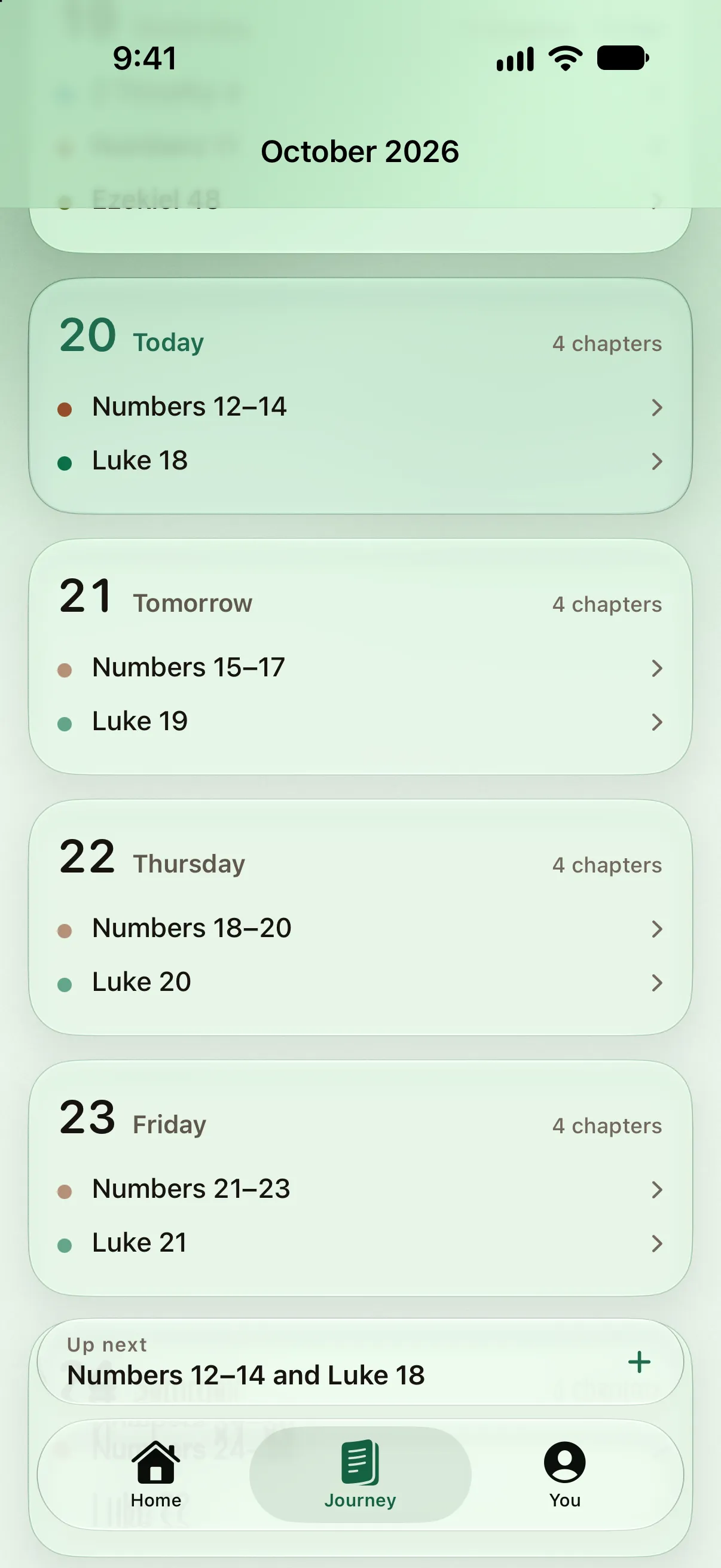
A plan that works with ADHD gives each day its own small portion and lets a missed day pass, rather than adding it to tomorrow. A dated plan with no give in it turns every missed day into a debt, and a growing count of “days behind” is one more thing that is easy to avoid looking at.
There are three simple ways around that:
- Read the next chapter, not “day 47”. An undated list of every chapter, ticked as you go, never falls behind, because it has no dates.
- With a dated plan, move forward rather than catch up. Read today’s portion, and either let the missed readings go or slide the whole plan back. Our guide to catching up on a Bible reading plan covers both.
- Mix the books. Reading some of the Old Testament and some of the New each day keeps a long run of laws or lists from lasting for weeks.
If you like a streak, one that allows a quiet day is easier to live with than one that resets to zero. An unbroken chain can be motivating while it holds and discouraging the morning it breaks; our guide to Bible reading streaks weighs both sides.
Treat a long, focused day as a bonus
Some days focus arrives all at once, and you might read all of Luke (about an hour and three quarters) without noticing the time. Enjoy that day, and keep tomorrow’s amount where it was. Raising the daily target after a big day makes the next ordinary day look like a shortfall, and ordinary days are what a reading habit is built from.
Make your progress visible
A record you can see, such as a chart with a box for every chapter or a list of books to tick off, shows what is done rather than what is left, and it only ever grows. On a day when it feels as if you never read, the filled boxes say otherwise.
Paper does this well. Our printable Bible reading tracker puts every chapter in a box, by book and division, on one or two pages, with a version for each of five canons. Keep it inside the cover of the Bible you read, so the record and the reading stay together.
How to study the Bible with ADHD
Studying the Bible with ADHD can be a few verses read slowly, in a set shape that gives your attention a sequence to follow, rather than an hour with a commentary. The Christians with ADHD in a 2024 Christianity Today piece on praying with ADHD described several such shapes:
- Lectio divina. ADHD coach Alex Hey often uses this monastic practice, a formula for reading, meditating, praying and contemplating, to engage Scripture, and it keeps his mind connected to the text. A few verses are enough to work with.
- Written prayers. Michael Agapito, a graduate student at Northern Seminary, finds quiet time daunting and uses lectio divina, The Book of Common Prayer and the Jesus Prayer.
- The church calendar. Emily Hubbard’s church, New City South in St. Louis, observes it, and she sees grace in its cycles: if one season is hard to focus in, there will be a next time.
A fixed time, place and cue is structure too: a spot for your Bible, a pen and a notebook, and the reading tied to something you already do every day, like the first coffee. As Anna Meherg, a student support services coordinator at the University of Mobile, told The Alabama Baptist, “Your quiet time doesn’t have to look like our grandparents’ quiet time.”
When it still isn’t working
Change the method before you draw any conclusions about yourself. Try another time of day, another book, audio instead of print, or half the amount. A method that helps for a season and then stops helping is ordinary, and swapping it is part of the habit.
Coming back after weeks or months away works the same way as starting: choose a short book and read today’s portion. Our guide to starting again after a long break has more on that.
ADHD itself, including focus, sleep and whether treatment would help, is worth talking through with a doctor or clinician. The Christianity Today piece notes that, in addition to counseling and medication, people with ADHD can develop coping strategies. A pastor or priest who knows you can help with the rest.
Five minutes with Jonah on a Tuesday goes in the record exactly as a long Sunday afternoon does.
Questions people ask
Is there a Bible reading plan for ADHD?
The shape of a plan matters more than its label. Look for a small daily portion, ideally set in minutes, a mix of books so a long stretch of laws or genealogies never lasts for weeks, and no backlog after a missed day. An undated list of chapters, read a few minutes at a time and ticked as you go, can never fall behind, because it has no dates.
Which book of the Bible should I start with if I have ADHD?
Mark is a good first book. It is the shortest Gospel, 16 chapters and about an hour of reading in all, and it moves quickly from scene to scene. After it, Jonah takes about five minutes, Ruth about ten, and Philippians and James about nine each, so each one is finished in a sitting or two.
Is listening to the Bible as good as reading it?
Listening is a real way of taking in Scripture, and Revelation opens with a blessing on those who hear its words as well as the one who reads them. You can also combine the two, following the printed text while an audio Bible plays, so the voice sets the pace. A chapter heard on a walk belongs in your record as much as one read at a desk.
Is there a Bible edition designed for people with ADHD?
Zondervan publishes the Clear Focus Bible, in the NIV, NIrV, NASB and Spanish NVI, which prints part of each word in bold and uses generous line spacing and uncluttered pages. Its publisher describes it as meant for readers whose minds wander, and its children's edition names dyslexia and ADHD. Whether the bolded type helps is personal, so a sample page is worth a look first.
How do I study the Bible with ADHD?
Study a short passage slowly, in a set shape, rather than a long one in a long sitting. Lectio divina gives four steps for a few verses (reading, meditating, praying and contemplating), and a pen helps: underline, color-code or write one line about what you noticed. Following a person or a theme that interests you is a fair way to study as well.
Sources
- Staley, B. S. et al. (2024). Attention-Deficit/Hyperactivity Disorder Diagnosis, Treatment, and Telehealth Use in Adults: National Center for Health Statistics Rapid Surveys System, United States, October–November 2023. MMWR 73(40).
- Fowler, M. (2024). How to Pray with ADHD. Christianity Today.
- Learning disorders like ADHD may interfere with Bible study but help is available, The Alabama Baptist (24 January 2020)
- Clear Focus Bible, Zondervan
- The Clear Focus Bible, The Banner (20 January 2026)
- Brysbaert, M. (2019). How many words do we read per minute? A review and meta-analysis of reading rate. Journal of Memory and Language, 109, 104047.
- World English Bible, verse-per-line edition (public domain), eBible.org