How to start reading the Bible again after a long break
Coming back to the Bible after months or years away? Where to start again, short books to begin with, how much to read a day, and why past reading counts.

The short answer
Start small, and start where you are. If you remember where you stopped, reread that chapter and carry on; if not, begin a short book you can finish this week, such as Jonah (about 5 minutes), Philippians or James (under 10 each) or Mark (about an hour). Read five to ten minutes a day, tied to something you already do, like breakfast. What you read before still counts, so there is nothing to start over and no missed days to make up.
In this guide
- Starting again is not starting over
- Should you start from the beginning or pick up where you stopped?
- Where to start reading the Bible again
- How much to read when you get back into it
- Tie it to something you already do
- You don’t need to wait for January
- If guilt is what keeps you away
- After the first book
- Questions people ask
- Sources
Most people who look up how to start reading the Bible again are not beginners. They read a Gospel once, or got a few months into a plan, and then a move, a new baby, an illness or simply a full season took the time, and the Bible stayed on the shelf. Coming back is different from starting for the first time: you know roughly what is in there, you may remember where it got hard, and the time away can weigh more than the reading itself. What follows is written for that return: where to re-enter, what to read first, and how little a day is enough.
- 5 minJonah, all four chapters
- 1 hourthe Gospel of Mark, start to finish
- 10 mina day reads the 66-book Bible in about 13 months
- 260days for the New Testament at a chapter a day
Starting again is not starting over
Whatever you read before still counts, so starting again does not mean going back to zero. You are also in large company. A Lifeway Research study found that 9 in 10 Americans have read at least some of the Bible, but only 22% have read all of it at least once, which means most people stand somewhere in the middle, with some books read and others not yet opened.
Stopping is often not a decision at all. In Lifeway Research’s February 2026 report on how often churchgoers read the Bible, its executive director, Scott McConnell, noted that “movement away from this devotion can start out as a slow drift.” A reading that drifted off can drift back, and the first step is knowing what you already have.
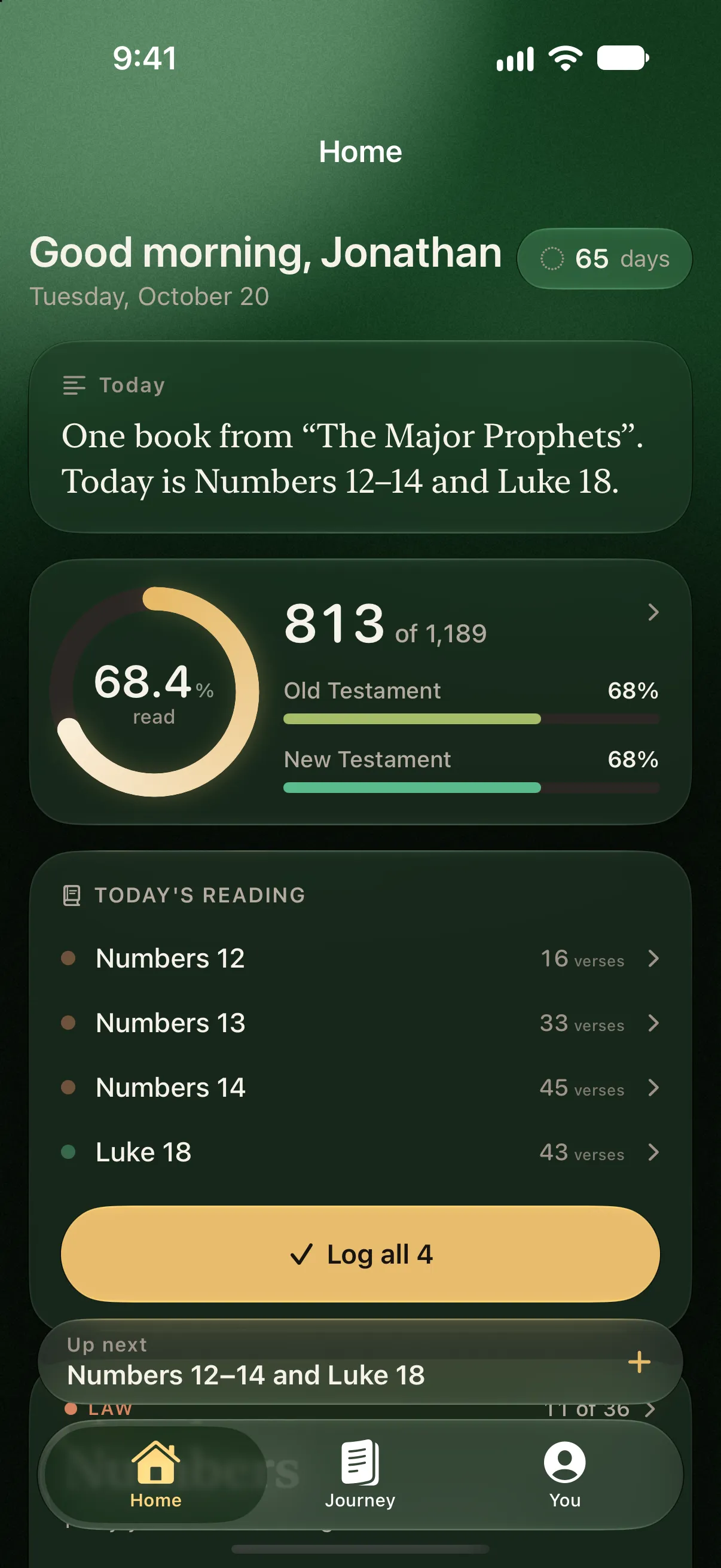
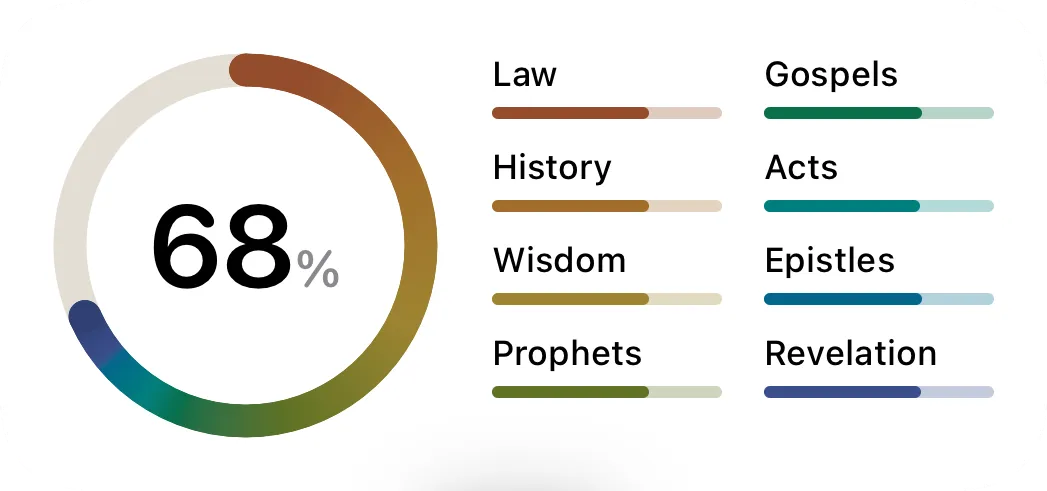
Before you open the Bible, take five minutes to write down the books you know you finished: a Gospel read with a study group, Genesis from a plan that stalled in Leviticus, the Psalms you keep returning to. Someone who has read the four Gospels and Genesis has already read 139 of the 1,189 chapters in the Protestant Bible (66 books), about 12%, or about 10% of the Catholic Bible’s 1,334. Our checker for how much of the Bible you have read does this book by book, for every canon. Books you only half remember can stay unmarked: you will meet them again, and a few reread chapters cost minutes.
Should you start from the beginning or pick up where you stopped?
Pick up where you stopped if you remember where that was and roughly what came before it; otherwise, start a new, short book and come back to the old place later. How long you were away matters less than how much of the thread you still hold.
| Where you are | A good way back in |
|---|---|
| A few weeks away, mid-book, and you remember it | Reread the last chapter you finished, then carry on |
| Months away, partway through a long book such as Leviticus, Isaiah or Jeremiah | Read a short book first, then return to the long one fresh |
| Stopped partway through a plan with dates | Take up the plan at your next unread reading, not at today’s date |
| Years away, or you can’t remember where you were | Start a Gospel: Mark takes about an hour in all |
| You want the whole story again, in order | Begin at Genesis, knowing the law comes early |
Rereading the last chapter you finished, or skimming the section headings from the start of the book, is usually enough to find the thread of a story again. A letter is easier still: most of Paul’s are short enough to begin again from the first verse.
Starting again from Genesis 1
Genesis is a good restart if a cover-to-cover reading is what you want. It is 50 chapters, almost all story, about two and a half hours of reading in all. What follows it is different: from chapter 20, Exodus turns to law, and much of its second half describes the tabernacle in close detail; Leviticus gives most of its 27 chapters to sacrifice, priesthood and purity, and a reading from the front reaches it at chapter 91 of 1,189. If that is where you stopped last time, a route that reads a little of the Old and New Testaments each day keeps the same stretch from arriving all at once. Our guide to the best order to read the Bible compares four routes through it.
If you stopped partway through a plan
A plan with dates puts the gap on the page: open a year plan in October that stopped in March, and seven months of readings sit there unticked. They are not owed. Carry on from the next reading you have not done and let the end date move, or begin the plan again at day one, starting today. Our guide to falling behind on a reading plan sets out both.
Where to start reading the Bible again
A good place to start reading the Bible again is a short book you can finish within a week, because a finished book is the first sign the habit is back. Most of these take ten minutes or less in all; the two Gospels take an hour or so each.
| Read | Chapters | Reading time | Why it suits a return |
|---|---|---|---|
| Luke 15 | 1 | about 3 minutes | A lost sheep, a lost coin and a son who comes home |
| Jonah | 4 | about 5 minutes | A prophet who runs the other way, and is sent a second time |
| Philippians | 4 | about 9 minutes | A warm letter, written from prison |
| James | 5 | about 9 minutes | Short, practical chapters |
| Ruth | 4 | about 10 minutes | Naomi comes home to Bethlehem after years in Moab |
| Mark | 16 | about 1 hour | The story of Jesus, told at speed |
| John | 21 | about 1 hour 20 minutes | Fewer events, each one stayed with longer |
Reading times are for silent reading at 238 words a minute, the adult average for non-fiction in a 2019 review of reading-rate research, over our own word count of the World English Bible, a modern public-domain translation. At a slower, more reflective pace, add about a fifth.
Jonah is the shortest whole book on the list, and its third chapter opens with a line that suits anyone coming back: “Yahweh’s word came to Jonah the second time” (Jonah 3:1). Luke 15 is a single chapter, so it makes a good first day on its own, with the rest of Luke there to read on into.
Two books suit reading alongside rather than straight through. A psalm averages about 275 words, a little over a minute, and one a day is an easy companion to whatever else you are reading. Proverbs has 31 chapters of about two minutes each, one for each day of a long month. For the choices a first-time reader faces, and a 30-day route through Mark and John, see where to start reading the Bible.
How much to read when you get back into it
Start with less than you think: five to ten minutes, or one to three chapters, is plenty, and an amount you could keep on a tired day does more than one you managed on your best. The table shows where each daily amount leads, at about 3.3 minutes a chapter, a relaxed pace that leaves room for the longer chapters.
| Minutes a day | Chapters a day | The New Testament (260 chapters) | The whole Protestant Bible (1,189 chapters) |
|---|---|---|---|
| 5 | about 1½ | just under 6 months | about 26 months |
| 10 | about 3 | just under 3 months | about 13 months |
| 15 | about 4½ | about 2 months | about 8½ months |
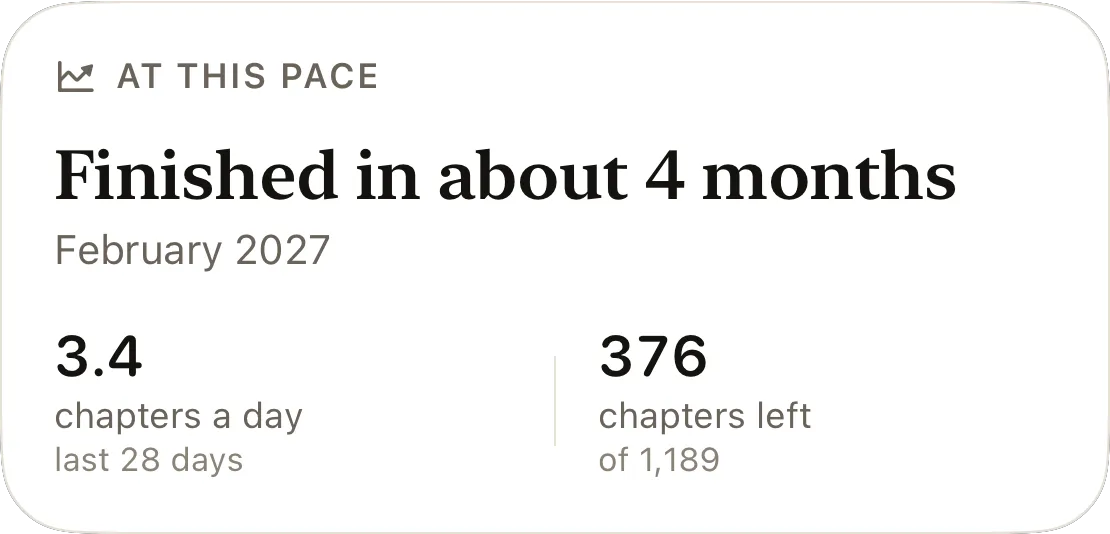
A chapter a day, with no clock at all, reads the New Testament in 260 days, about eight and a half months. If the first week feels slow, the amount can grow once the reading has a place in the day; adding a chapter later is easier than coming back from a target set too high. Our guide to how many minutes a day to read the Bible looks at each amount more closely.
Tie it to something you already do
A daily habit forms around a cue, so attach the reading to something already fixed in your day: the first coffee, the train to work, the quiet after the children are in bed.
That is the setup of a widely cited study of how habits form. In research published in 2010, 96 volunteers each chose one behavior to repeat daily in the same context, “after breakfast” being the example the paper gives, for twelve weeks. The time it took for a behavior to become nearly as automatic as it would get ranged from 18 to 254 days, and the lead author, Pippa Lally, has since given the average as 66 days. One finding matters most for anyone starting again: missing one opportunity did not materially affect the habit forming.
- Choose the cue, not only the time. “After breakfast” survives a late morning; “at 7:00” does not.
- Keep the Bible where the cue happens. On the breakfast table, open at the next chapter, or the app you read in on your phone’s first screen.
- Decide the passage the night before. Starting is easier when there is nothing to choose.
- Let a missed day be a missed day. The next morning is the next opportunity, not a debt.
You don’t need to wait for January
Any day can be the day you start again. People do lean on fresh starts: a 2014 study by Hengchen Dai, Katherine Milkman and Jason Riis found that Google searches for “diet,” gym visits and commitments to pursue goals all rise after temporal landmarks such as the start of a new week, month or year, a birthday or a holiday. The authors propose that these landmarks open new mental accounting periods, which “relegate past imperfections to a previous period.”
That cuts both ways. A landmark close at hand, such as a new week or month, or the start of Advent or Lent, may give a restart some lift. But the lift comes from drawing a line under the past, and that line can be drawn today, without waiting for a date to draw it for you.
It is never too late in the year for a year-long plan, either. A year can begin on any date: start today, and a little over three chapters a day finishes 365 days from now. Our guide to reading the Bible in a year has the plans and the pace.
If guilt is what keeps you away
The time away does not need to be made up, counted or explained before you read again. For some readers the hardest part of coming back is not finding the place but facing the gap: the bookmark still in March, the plan with its rows of unread days. None of that has to be settled first. The chapter you read today is read, and the months before it are not a debt it has to repay.
It is because of Yahweh’s loving kindnesses that we are not consumed, because his mercies don’t fail. They are new every morning. Great is your faithfulness.
Lamentations 3:22–23, World English Bible
In practice that means no catching up, no tally of days missed and no grand restart. Read today’s chapter as if it were the only one on the list, because today it is.
After the first book
Once a short book is finished, choose a route for the next few months. Four that suit a returning reader:
- A second book of the same kind. After Mark, Luke or Acts; after Philippians, Colossians (about 8 minutes) or 1 Peter (about 10).
- A chapter a day through the New Testament. 260 chapters, no dates, about eight and a half months.
- The whole Bible over a year. A little over three chapters a day, about ten or eleven minutes.
- The Old and New Testaments together. A little of each every day, so neither the long histories nor the prophets arrive all at once.
Open the Bible at the chapter after the last one you remember, or at Mark 1, and read it. That is the whole of starting again.
Questions people ask
Should I start reading the Bible from the beginning again?
Only if a cover-to-cover reading is what you want. Genesis is almost all story, but the law arrives early: Exodus turns to it at chapter 20, and Leviticus begins at chapter 91 of the Protestant Bible's 1,189. If that is where you stopped before, a Gospel first, or a plan that reads a little of each testament every day, keeps the same stretch from arriving in the same first weeks.
Where should I start reading the Bible after backsliding?
Anywhere that feels like a way back in, because there is no wrong place to begin. A Gospel is a common choice, and Luke 15, about three minutes long, tells of a lost sheep, a lost coin and a son whose father runs to meet him. The Psalms suit a return too. Read a chapter a day and let the time away stay where it is, behind you.
What if I can't remember where I stopped?
Start a new book rather than hunting for the old place. Pick a short one, such as Philippians or James at under ten minutes each, or a Gospel. Mark off only the books you are sure you finished and leave the half-read ones unmarked; you will reach them again, and rereading a few chapters costs minutes, not days.
Is it too late in the year to start a Bible-in-a-year plan?
No. A year can start on any date: begin today and you finish 365 days from now at a little over three chapters a day, about ten or eleven minutes. Finishing by December 31 is a different and much heavier plan once the year is well along; starting on November 1, with 61 days left, it would take nearly 20 chapters a day.
How long does it take to get back into a daily Bible reading habit?
There is no fixed number. In a 2010 study of 96 volunteers repeating one daily behavior in the same context, the time it took for the behavior to become nearly as automatic as it would get ranged from 18 to 254 days, and the lead researcher has given the average as 66 days. Missing a single day did not materially affect the process, so one quiet day is no reason to start over.
Sources
- Lifeway Research (February 10, 2026), Lifeway Research Finds Fewer Than 1 in 3 Churchgoers Read the Bible Daily
- Lally, P., van Jaarsveld, C. H. M., Potts, H. W. W. & Wardle, J. (2010). How are habits formed: Modelling habit formation in the real world. European Journal of Social Psychology, 40(6), 998–1009.
- University of Surrey (January 21, 2026), Does it really take 66 days to form a habit? We asked the expert, Dr Pippa Lally
- Dai, H., Milkman, K. L. & Riis, J. (2014). The Fresh Start Effect: Temporal Landmarks Motivate Aspirational Behavior. Management Science, 60(10), 2563–2582.
- Brysbaert, M. (2019). How many words do we read per minute? A review and meta-analysis of reading rate. Journal of Memory and Language, 109, 104047.
- World English Bible, verse-per-line edition (public domain), eBible.org
- King James Version, verse-per-line edition (public domain), eBible.org