Bible reading streaks: helpful or harmful?
Lost your Bible reading streak? What the research says a streak does for a habit, what a broken one does, and a kinder rule that lets one quiet day pass.

The short answer
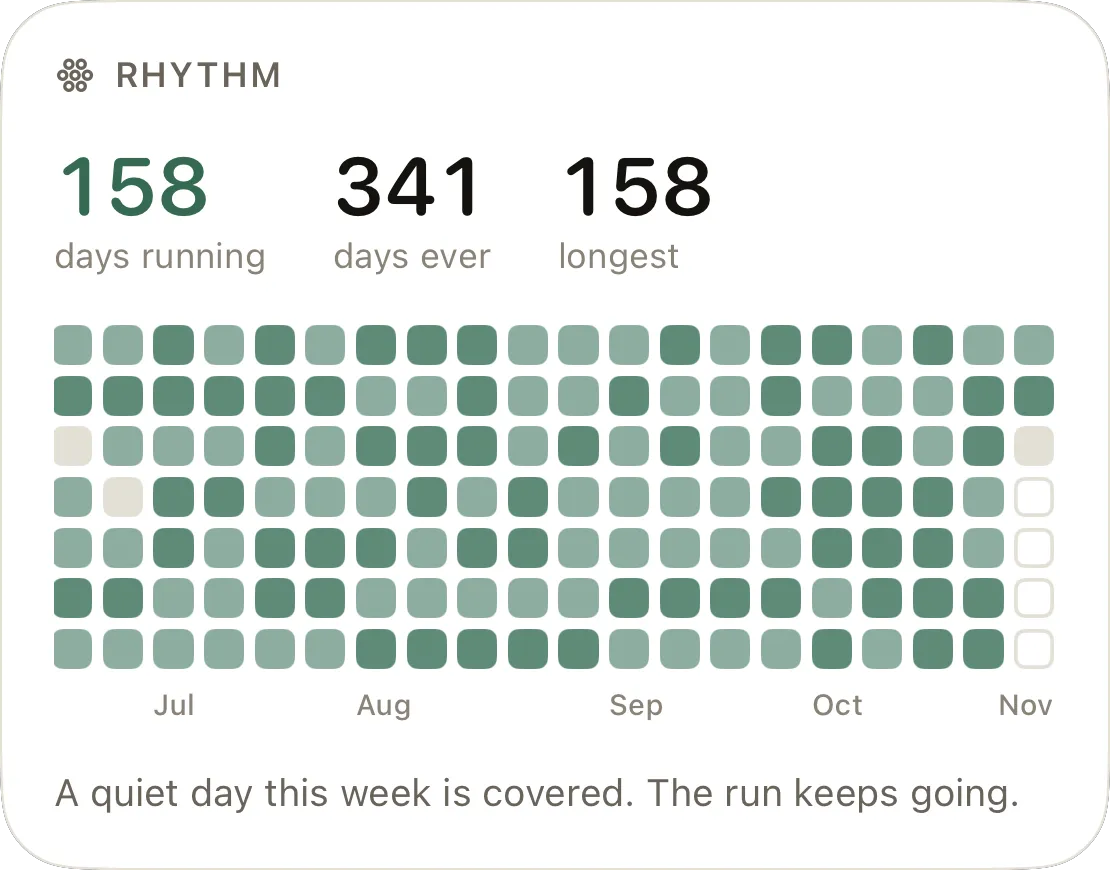
A Bible reading streak counts the days in a row you have read, and it does help some people: seeing an unbroken run makes people more likely to keep going. The cost comes when it breaks. Research on logged streaks finds engagement drops after a visible break, more when people blame themselves and less when the streak can be repaired. A forgiving rule, such as one quiet day allowed and earned back by a week of reading, keeps most of the benefit and softens the cliff.
In this guide
- What a Bible reading streak counts, and what it doesn’t
- Why streaks work
- What happens when a streak breaks
- Lost your Bible app streak? What to do next
- Streak anxiety: when the number becomes the point
- A streak that forgives: grace days and weekly goals
- Better things to count than days in a row
- Keep the streak or turn it off?
- Questions people ask
- Sources
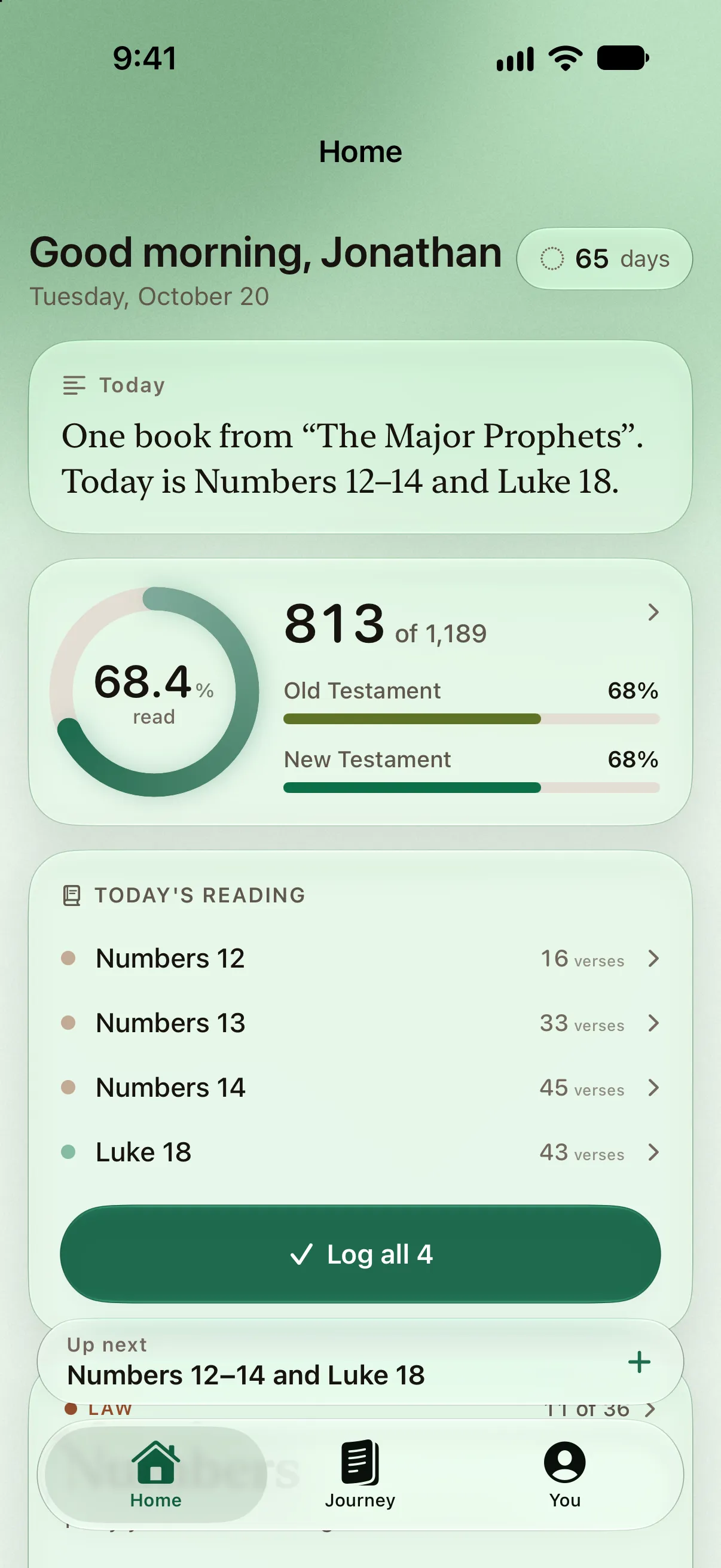
A streak is the simplest record a habit can keep: one number that grows each day you show up and goes back to zero the day you don’t. Many Bible apps show one, and some readers keep a Bible reading streak on paper. It helps some people and quietly wears others down. The research on streaks explains both, and it points to what helps when a long one ends.
What a Bible reading streak counts, and what it doesn’t
A Bible reading streak counts the consecutive days on which you read, or did whatever your app treats as reading that day. It measures one thing well: how regularly you come back. It says nothing about how much you read, how closely you read it, or how much of the Bible you have covered.
Two readers make the difference plain. One reads a chapter every day for 60 days. The other reads four chapters each weekday for twelve weeks and rests on weekends. Both read on 60 days.
| Reader A | Reader B | |
|---|---|---|
| Pattern | 1 chapter, every day | 4 chapters, weekdays only |
| Days read | 60 | 60 |
| Longest streak | 60 | 5 |
| Chapters read | 60 | 240 |
| Share of the Protestant Bible (1,189 chapters) | about 5% | about 20% |
Plenty of regular readers look like Reader B. In a March 2025 Lifeway Research survey of 2,130 Protestant churchgoers in the US, 31% said they read the Bible every day and another 30% a few times a week. A streak that resets on every gap has little to say about the second group, though they read the Bible regularly by any ordinary measure. Our guide to how often Christians read the Bible has more of the survey figures.
Why streaks work
Streaks work because a visible, unbroken run becomes a goal in its own right, and people keep going to protect it. That is the finding of a 2023 paper in the Journal of Consumer Research by Jackie Silverman and Alixandra Barasch, who ran seven studies on logged streaks, which they define as a behavior repeated three or more times in a row. An intact streak shown in a log made people more likely to do the same thing again than a broken one did.
The striking part is what drove it. The effect was independent of what people had actually done, and depended solely on how the log showed it. Two readers with the same history can behave differently tomorrow depending on whether their screen shows an unbroken run or a gap.
Duolingo, the language-learning app, reports the same pull in its own data: learners who reach a 7-day streak are 3.6 times more likely to complete their course. That is the company’s figure, and a comparison rather than proof of cause, since the people who keep a week going may be the ones who would have finished anyway. The pull itself is easy to recognize. A streak makes a small daily act visible, and on a tired evening, a number you would rather not lose can be what gets the Bible open.
What happens when a streak breaks
When a streak breaks, the same pull works in reverse, and the break itself can become a reason to stop. Silverman and Barasch found that the gap between intact and broken streaks grew when people blamed the break on themselves rather than on circumstances, and shrank when they could repair the streak. Their paper names the cost a broken streak can carry for the companies that display streaks: reduced engagement, or giving up altogether.
Duolingo’s own blog says much the same in plainer words: losing a day and breaking a streak “can have the opposite effect, and actually feel quite demotivating.” The longer the run, the more there is to lose, which is why a 200-day streak ending can feel heavier than the single quiet day that ended it.
Lost your Bible app streak? What to do next
Read something today, and let the count start again from one. The days behind it still happened and the chapters are still read; only the number changed.
- Read one chapter today. Not a make-up for the missed day, just today’s. A short one is fine. If you were on a plan and the missed days have piled up, our guide to catching up on a reading plan covers that.
- Ask the app, not a forum. Whether a lost streak can be restored, frozen or repaired depends entirely on the app you use, and its own help pages are the only reliable answer. A fix that worked for someone else may not apply to yours.
- Be accurate about why it broke. If the cause was outside you (a hospital stay, a newborn, a night shift, a phone that died), say so to yourself. In Silverman and Barasch’s studies, a break put down to circumstances did less damage than one people blamed on themselves.
- Look at a number that didn’t reset. Count the chapters, or the books, you read during the streak. That total is the same today as it was yesterday.
The book of Lamentations, written over a ruined city, still finds a reason to begin again each day:
It is because of Yahweh’s loving kindnesses that we are not consumed, because his mercies don’t fail. They are new every morning. Great is your faithfulness.
Lamentations 3:22–23, World English Bible
If the gap has run to weeks or months rather than a day or two, starting again after a long break is the better guide.
Streak anxiety: when the number becomes the point
Streak anxiety is the point at which keeping the count matters more than the reading it was meant to count. It tends to show up in a few recognizable ways:
- Choosing by length. The shortest chapter wins because it is the quickest way to keep the number alive.
- The late-night save. A verse at a quarter to midnight, read for the count rather than for itself.
- Dread before desire. You notice the streak before you notice whether you want to read.
- The cliff. Once the run breaks, the habit goes with it for weeks.
None of this makes caring about a streak wrong. For many readers the number is a harmless nudge, and nothing about wanting to see it grow is unspiritual.
The Lifeway survey offers a useful contrast. Of the churchgoers it asked, 62% said they desperately miss time with God when they go several days without reading the Bible. That is a feeling about the reading itself. Streak anxiety is a feeling about a counter. Many readers feel some of both, and it helps to know which one is doing the work on a given evening.
A streak that forgives: grace days and weekly goals
A streak that allows a skip keeps most of the pull and loses most of the cliff, and the research supports building one in. In a month-long step challenge with more than 270 college students and staff, researchers Sharif and Shu gave people different rules. Some had to meet their goal five days a week, some all seven, and two groups had a seven-day goal with emergency skips: two a week, or eight across the month.
The groups with skips reached their goals up to 40% more often than either of the others. On the day after a miss, people with two skips a week met their goal 55% of the time, against 37% for those who had to manage all seven. A rule with room in it made people more likely to get straight back on.
Duolingo builds the same room into its own streak. Its Streak Freeze pauses the streak for a day, and when the company let learners hold two at once, the number of learners active each day went up slightly (by 0.38%) rather than down.
Habit research points the same way. In Phillippa Lally’s 2010 study of people forming a new daily habit, missing one opportunity did not materially affect how the habit formed. The same study found that the time it took a new behavior to become close to automatic ranged from 18 to 254 days, so a habit that still takes effort after a month is not running late.
| Study | What it looked at | What it found |
|---|---|---|
| Silverman and Barasch (2023) | Logged streaks, seven studies | An intact streak raised later engagement compared with a broken one; self-blame made a break worse, a way to repair it made it milder |
| Duolingo (company data, 2022) | Language learners | A 7-day streak went with 3.6 times the course completion; letting learners hold two Streak Freezes raised daily active learners by 0.38% |
| Sharif and Shu | A month-long step challenge, 270+ people | With two skips a week, the goal was met on 55% of days after a miss, against 37% with a seven-day goal and no skips |
| Lally and colleagues (2010) | Forming a new daily habit | Missing one opportunity did not materially affect habit formation |
You can write a forgiving rule for yourself, in an app or on paper. Three that are easy to keep:
- One grace day, earned back. A single quiet day doesn’t break the run, and a full week of reading earns the grace day back. On a paper chart, mark the grace day in a different color.
- Days a week, not days in a row. Aim for five days out of seven and count the week as kept.
- A rolling four weeks. Count how many of the last 28 days you read. A quiet week dents the number; it never falls to zero overnight.
Better things to count than days in a row
For most readers the most useful number is how much of the Bible they have read, because no quiet day can take it away. A streak answers one question: whether you read yesterday. Chapters and books answer another, how far you have come, and that number only grows.
| What you count | What one quiet day does to it | Most useful for |
|---|---|---|
| Days in a row | Resets it to zero | The first few weeks of a new habit |
| Days in a row, with a grace day | Nothing, while the grace day is there | Keeping the nudge without the cliff |
| Days read in the last 4 weeks | Leaves it one lower until that day drops out | Seeing your real rhythm |
| Days read in total | Nothing | A record that only grows |
| Chapters read | Nothing | Seeing the ground you have covered |
| Books finished | Nothing | Milestones worth marking |
| Share of the Bible read | Nothing | The whole picture: 1,189 chapters in the Protestant Bible, 1,334 in the Catholic |
Our guide to tracking your Bible reading compares paper, spreadsheets and apps for keeping these, and the Bible reading checker works out your share of the Bible from the books you have finished.
Keep the streak or turn it off?
Keep the streak if it gets your Bible open on days you otherwise wouldn’t, and turn it off (or stop looking at it) if a break leaves you less likely to read the next day. The same number can do either, depending on the reader and the season.
A streak tends to help:
- in the first few weeks of a new habit, when the reading has not yet found its place in the day;
- readers who like a visible record and shrug when it resets;
- a short season with a clear end, such as Lent or Advent.
It tends to become a strain:
- in weeks that are irregular by nature (shift work, small children, travel, illness);
- in the days just after a long streak breaks;
- for anyone whose reason to read has become the number.
If you are unsure, try two weeks without it. Hide the streak or simply ignore it, and count chapters instead. If you read about as often, the number was not doing much. If you read less, it was earning its place. For the rest of a daily habit (a time, a place, an amount you can keep on a busy day), see how to read the Bible every day.
Whatever you count, the reading is the part that stays. A chapter read on a Tuesday after a quiet Monday is read just the same.
Questions people ask
Does missing one day ruin a Bible reading habit?
No. In a 2010 study of people forming a new daily habit, Phillippa Lally and colleagues found that missing one opportunity did not materially affect how the habit formed. A single quiet day did not undo the progress people had already made, so what carries a habit forward is reading again, not the day that was skipped.
How do I get my streak back on my Bible app?
It depends entirely on the app. Some apps offer a way to repair or protect a streak and some do not, so the app's own help pages or settings are the only reliable answer. Whatever the counter says, the chapters you read during the streak are still read, and reading one chapter today starts a new run.
What does a Bible app streak count?
Consecutive days on which you did whatever the app counts as activity for that day. Depending on the app, that might be finishing the day's reading or something smaller, and the app's own help pages are the place to check. A streak measures how regularly you came back. It does not measure how much you read, how carefully, or how much of the Bible you have covered.
Is it bad to care about a Bible reading streak?
No. For many people a streak is a useful nudge, and research on logged streaks shows that seeing an unbroken run makes people more likely to keep going. It turns unhelpful when the number becomes the reason for reading, such as picking the shortest chapter to save the count, or stopping for weeks once it breaks.
Should I turn off the streak in my Bible app?
Try it if a broken streak leaves you less likely to read the next day, or if you mostly read to protect the number. Keep it if it gets your Bible open on days you otherwise would not. A two-week test is a simple way to find out. Ignore the streak, count chapters instead, and see whether you read about as often as before.
Sources
- Silverman, J., & Barasch, A. (2023). On or off track: How (broken) streaks affect consumer decisions. Journal of Consumer Research, 49(6), 1095–1117. Summary, University of Colorado Boulder.
- Duolingo: How the Duolingo streak builds habit (January 31, 2022)
- UCLA Anderson Review: Emergency reserves, on Sharif & Shu, Nudging persistence after failure through emergency reserves, Organizational Behavior and Human Decision Processes
- Lally, P., van Jaarsveld, C. H. M., Potts, H. W. W., & Wardle, J. (2010). How are habits formed: Modelling habit formation in the real world. European Journal of Social Psychology, 40(6), 998–1009.
- Lifeway Research: Fewer than 1 in 3 churchgoers read the Bible daily (February 10, 2026)
- World English Bible, verse-per-line edition (public domain), eBible.org