No motivation to read the Bible? Why it's hard, and what helps
No motivation to read the Bible? Why it feels hard, the Old Testament stretch that slows January plans, and small changes that help, from 3 minutes a day.

The short answer
Losing motivation to read the Bible is common, and often the cause is the reading, not the reader. The Bible is a library of 66 or more books in eight kinds of writing, a front-to-back year plan reaches the laws of Exodus and Leviticus within a month, and daily targets tend to be set on a good day. What helps: read less (a chapter takes about three minutes), finish a short book first, mix the testaments, read with one question, and track what you've covered, not what you've missed.
In this guide
- Why is it so hard to read the Bible?
- Why is the Old Testament so hard to read?
- Is it normal to have no motivation to read the Bible?
- How to get motivated to read the Bible
- Count what you’ve read, not what you’ve missed
- On a day you don’t want to read
- Bible verses about reading the Bible
- Questions people ask
- Sources
Advice for having no motivation to read the Bible usually asks for more discipline. A more useful question is what about the reading makes it hard to come back to, because most of that can be changed: what you read, how much, in what order and what for. None of it needs you to feel more motivated first.
- 52 hoursthe whole 66-book Bible, read silently
- 3 minan average chapter, at a relaxed pace
- 8divisions, from the Law to Revelation
- 5books of the 66 only one chapter long
Why is it so hard to read the Bible?
The Bible is hard to keep reading because it is not one book but a library, written over many centuries in Hebrew, Aramaic and Greek: 66 books in a Protestant Bible, 73 in a Catholic one and more in Orthodox Bibles. A reader who opens it expecting one kind of writing keeps meeting another. Four things make it harder than it needs to be, and each of them can be changed.
It is a library, not a novel
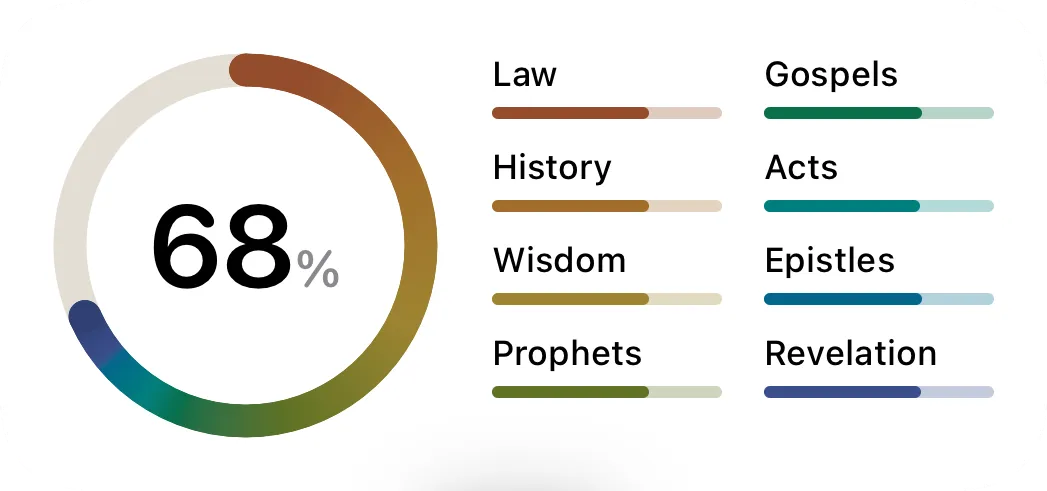
In one common grouping, the books fall into eight kinds: law, history, wisdom and poetry, the prophets, the Gospels, Acts, the letters, and Revelation. Each asks to be read differently. The Psalms are prayers and songs, Proverbs is a collection of sayings, Leviticus is a law code, and Romans is a long argument made one step at a time. Read at the same pace and in the same frame of mind, some of them will always feel slow. Our guide to the eight divisions of the Bible says what each kind is and which books belong to it.
The world behind it is far away
Names, places, measures and customs that were plain to the first readers need explaining now. That is not a modern problem. In the Book of Acts, an Ethiopian official riding home from Jerusalem is reading the prophet Isaiah when Philip catches up with him:
Philip ran to him, and heard him reading Isaiah the prophet, and said, “Do you understand what you are reading?” He said, “How can I, unless someone explains it to me?”
Acts 8:30–31, World English Bible
A short introduction read before you start a book, of the kind a study Bible prints, answers many of the questions that stop a reading. The translation matters too. The King James Version was published in 1611 and keeps the English of its day; if that is the Bible on your shelf, a modern translation reads in the language around you, and nothing stops you keeping both.
The daily amount was set on a good day
Plans tend to be chosen on a day of resolve and then read on ordinary days. A year-long plan is a little over three chapters a day, about 11 minutes. A 90-day plan is about 13 chapters, around 44 minutes, every day for three months. When a plan of that size starts to feel heavy, the trouble is often the size of the plan, not the reader.
It has started to feel like a test
Once a missed day feels like a mark against you, opening the Bible means facing the gap first, and that is one more reason to put it off. A dated plan with rows of unread days, or a streak counter back at zero, can make one quiet day feel far bigger than it was. Our guide to Bible reading streaks looks at when a streak helps and when it gets in the way.
Why is the Old Testament so hard to read?
The Old Testament is 929 of the Protestant Bible’s 1,189 chapters, close to four in five, and it holds most of the Bible’s law codes, census lists, genealogies and building instructions. Read in the usual order, several of them come early. These are the stretches least like the stories around them:
| Where | Chapters | What is on the page |
|---|---|---|
| Exodus 25–31 and 35–40 | 13 | The tabernacle: its pattern, its furniture, and the building of it |
| Leviticus | 27 | Offerings, priests, what is clean and unclean, and the feasts |
| Numbers 1–4 and 26 | 5 | Two censuses, the order of the camp and the Levites’ duties |
| Joshua 13–21 | 9 | The land divided among the tribes, and the cities set apart |
| 1 Chronicles 1–9 | 9 | Genealogies, beginning with Adam |
| Ezekiel 40–48 | 9 | A vision of a temple, measured out in detail |
In a start-to-finish plan begun on January 1, at a little over three chapters a day, Exodus 25 arrives around January 24, Leviticus around January 28, and Numbers lasts until about February 16. If your reading began in January and slowed before March, it is worth looking at what was on the page. A few things make these stretches easier:
- Know what the section is for. Leviticus sets out how a holy people is meant to live, and it is where “you shall love your neighbor as yourself” first appears (Leviticus 19:18). In Matthew 22, Jesus gives that line as the second commandment, after loving God with all your heart.
- Size it honestly. Leviticus takes a little over an hour and a half to read in full at an average silent pace, and Numbers a little over two hours. Spread over two weeks, Leviticus is about seven minutes a day.
- Pair it with something else. A Gospel chapter or a psalm on the same day keeps a slow week from being only slow. A plan that reads the Old and New Testaments together does this every day; our guide to the best order to read the Bible compares it with the other routes.
- Let a list be a list. Genealogies and census tables were written to record a family line or a people, and they can be read at the pace of a list.
Is it normal to have no motivation to read the Bible?
Yes, and the surveys show how ordinary it is. In a Lifeway Research survey of 1,200 Americans in August 2024, people were asked why they don’t read the Bible more. These were their answers:
| Reason given | Share |
|---|---|
| They don’t prioritize it | 24% |
| They don’t have time | 15% |
| They’ve read enough of it | 14% |
| They’re intimidated by the size of the Bible | 11% |
| They don’t own a copy | 10% |
| They don’t read books | 9% |
| They don’t agree with what it says | 8% |
| They don’t see how it relates to them | 8% |
| They prefer other spiritual books | 6% |
| None of these | 30% |
The size, at least, is smaller than it looks: the whole Protestant Bible is about 52 hours of silent reading, and an average chapter takes about three minutes.
Churchgoers know the feeling too. In a separate Lifeway survey of 2,130 American Protestant churchgoers (people who attend services at least once a month) in March 2025, 31% said Bible reading was a daily habit. Asked about going several days without it, 62% said they desperately miss the time with God, while 21% were unsure and 17% disagreed. Close to four in ten churchgoers, in other words, did not describe that pull.
Scripture has room for this. Psalm 119 is the longest chapter in the Bible, 176 verses in praise of God’s word, and it includes this line:
My soul is weary with sorrow; strengthen me according to your word.
Psalm 119:28, World English Bible
What a dry season means for your faith is a question for your own tradition, and for a pastor or priest who knows you. The practical side is the same for everyone, and it is mostly about making the next reading easier to start.
How to get motivated to read the Bible
It is usually easier to change the reading than to wait for the motivation. Each change below makes the next sitting smaller, more interesting, or easier to see the point of, and together they are most of what keeps Bible reading from getting boring.
Read less than you think you need
One chapter takes about three minutes at a relaxed pace. Five minutes a day, about a chapter and a half, still reads the whole Protestant Bible in a little over two years, and one chapter a day reads the New Testament in 260 days. A small amount you keep reading does more than a large one you put off, and it can always grow later. Our guide to how many minutes a day to read the Bible compares the amounts.
Start with a book you can finish
A finished book is something to show for the week. These can each be read in one sitting or over a few days:
| Book | Chapters | Reading time | What it’s known for |
|---|---|---|---|
| Ruth | 4 | 10 minutes | A widow's loyalty, four chapters long |
| Jonah | 4 | 5 minutes | The prophet who ran the other way |
| Habakkuk | 3 | 6 minutes | A prophet who argues, and is answered |
| Mark | 16 | 1 hour | The fastest gospel — everything happens 'immediately' |
| Galatians | 6 | 13 minutes | Freedom, argued urgently |
| Philippians | 4 | 9 minutes | A joyful letter written from prison |
| Philemon | 1 | 2 minutes | One chapter about one runaway slave |
| James | 5 | 9 minutes | Blunt, practical, five chapters |
| 1 John | 5 | 10 minutes | “God is love” |
Words are our own count of the World English Bible, a public-domain modern translation. Reading time is silent reading at 238 words a minute, the adult average.
Mark is the shortest of the four Gospels and reads in about an hour. The Psalms work one at a time and in any order.
Put a stalled book down
If one book has stopped you, read another and come back to it later. Nothing about a stalled book has to be settled before the next one, and the chapters you read in it stay read.
Read with one question
A question gives the chapter a job. One as plain as “What does this show me about God?” or “Which line do I want to keep?” is enough, and writing the answer down makes the reading something to look back on. Our guide to keeping a Bible reading journal suggests one line a chapter.
Hear it, or read it with someone
Listening to an audio Bible on a walk or a commute covers ground a desk never would. Reading aloud is slower, at about 183 words a minute against 238 read silently, and harder to skim. Reading the same chapters as a friend or a spouse gives you someone to talk them over with, which is an old way to read: in Nehemiah 8 the law is read aloud from early morning until midday, and “they gave the sense, so that they understood the reading” (Nehemiah 8:8).
Count what you’ve read, not what you’ve missed
A record that only grows is easier to return to than one that shows the gaps. Progress you can see tends to pull you on. In a 2006 study, Ran Kivetz, Oleg Urminsky and Yuhuang Zheng found that members of a real café’s reward program bought coffee more often the closer they came to a free one. Customers given a 12-stamp card with two stamps already filled completed the ten purchases faster than customers given a plain 10-stamp card, though both needed the same ten.
Coffee is not Scripture, but the shape carries over. A chart on which every chapter read is filled in shows ground covered, and the books you read years ago can go on it too, so you start part of the way there rather than at zero. A tally of missed days keeps the gap in front of you instead. A printable Bible reading tracker gives every chapter a box.
On a day you don’t want to read
Read a little, or let the day pass. Psalm 23 is six verses, well under a minute. If even that is too much, the next reading is simply the next chapter, not a debt with the missed one added to it. In a 2010 study of 96 volunteers taking up a daily eating, drinking or activity habit, Phillippa Lally and her colleagues found that missing one opportunity “did not materially affect the habit formation process.”
Bible verses about reading the Bible
Several passages describe what Scripture was to the people who wrote them, and together they make a short reading for a slow day:
- Psalm 119:105. “Your word is a lamp to my feet, and a light for my path.”
- Isaiah 55:10–11. The word is like rain and snow that water the earth; it “will not return to me void.”
- Matthew 4:4. “Man shall not live by bread alone, but by every word that proceeds out of God’s mouth,” quoting Deuteronomy 8:3.
- Luke 24:32. Two disciples on the road to Emmaus: “Weren’t our hearts burning within us while he spoke to us along the way, and while he opened the Scriptures to us?”
- Hebrews 4:12. “For the word of God is living and active.”
A chapter read without wanting to is still a chapter read, and it counts exactly as much as the ones that came easily.
Questions people ask
Is it a sin to have no motivation to read the Bible?
Christian traditions answer questions of sin in their own ways, and a pastor or priest who knows you is the right person to ask. What Scripture does show is that weariness is not new: Psalm 119, the Bible's longest chapter and a poem in praise of God's word, says, “My soul is weary with sorrow.” A day without motivation can still hold one short chapter.
How do I read the Bible without getting bored?
Change the kind of reading rather than the amount of effort. Alternate stories, poetry and letters instead of spending weeks in one kind, pair a slow Old Testament stretch with a Gospel chapter on the same day, read with one question in mind, and try listening or reading aloud. A short book finished in one sitting, such as Jonah or Philippians, also leaves you with something done.
Why is the Bible so hard to understand?
It was written in Hebrew, Aramaic and Greek for readers in a very different world, and it mixes law, history, poetry, prophecy, letters and apocalypse. Some confusion is expected, and the Bible records it too: in Acts 8, an official reading Isaiah asks, “How can I, unless someone explains it to me?” A short introduction to each book and a modern translation answer many of them.
What can I read in the Bible when I have no motivation?
Something short and complete. At an average silent pace, Jonah takes about five minutes, Philippians and James under ten each, Ruth about ten, and the Gospel of Mark about an hour. The Psalms can be read one at a time and in any order. A whole book finished is an easier place to start from than the middle of a long one.
How do I get my motivation back after a long time away from the Bible?
Start small and from where you are, without making up the missed time. Choose a short book you can finish this week, read five to ten minutes a day at a point in the day you already keep, such as breakfast, and count what you read before as read. In habit research, a single missed day did not materially set a new habit back.
Sources
- Lifeway Research (May 13, 2025), Americans Judge the Good Book More Positively, but Still Often by Its Cover (online survey of 1,200 Americans, August 14–30, 2024)
- Lifeway Research (February 10, 2026), Fewer Than 1 in 3 Churchgoers Read the Bible Daily (online survey of 2,130 Protestant churchgoers, March 19–26, 2025)
- Kivetz, R., Urminsky, O. and Zheng, Y. (2006). The Goal-Gradient Hypothesis Resurrected: Purchase Acceleration, Illusionary Goal Progress, and Customer Retention. Journal of Marketing Research, 43(1), 39–58.
- Lally, P., van Jaarsveld, C. H. M., Potts, H. W. W. and Wardle, J. (2010). How are habits formed: Modelling habit formation in the real world. European Journal of Social Psychology, 40(6), 998–1009.
- Bible, Wikipedia (original languages)
- King James Version, Wikipedia
- Brysbaert, M. (2019). How many words do we read per minute? A review and meta-analysis of reading rate. Journal of Memory and Language, 109, 104047.
- World English Bible, verse-per-line edition (public domain), eBible.org