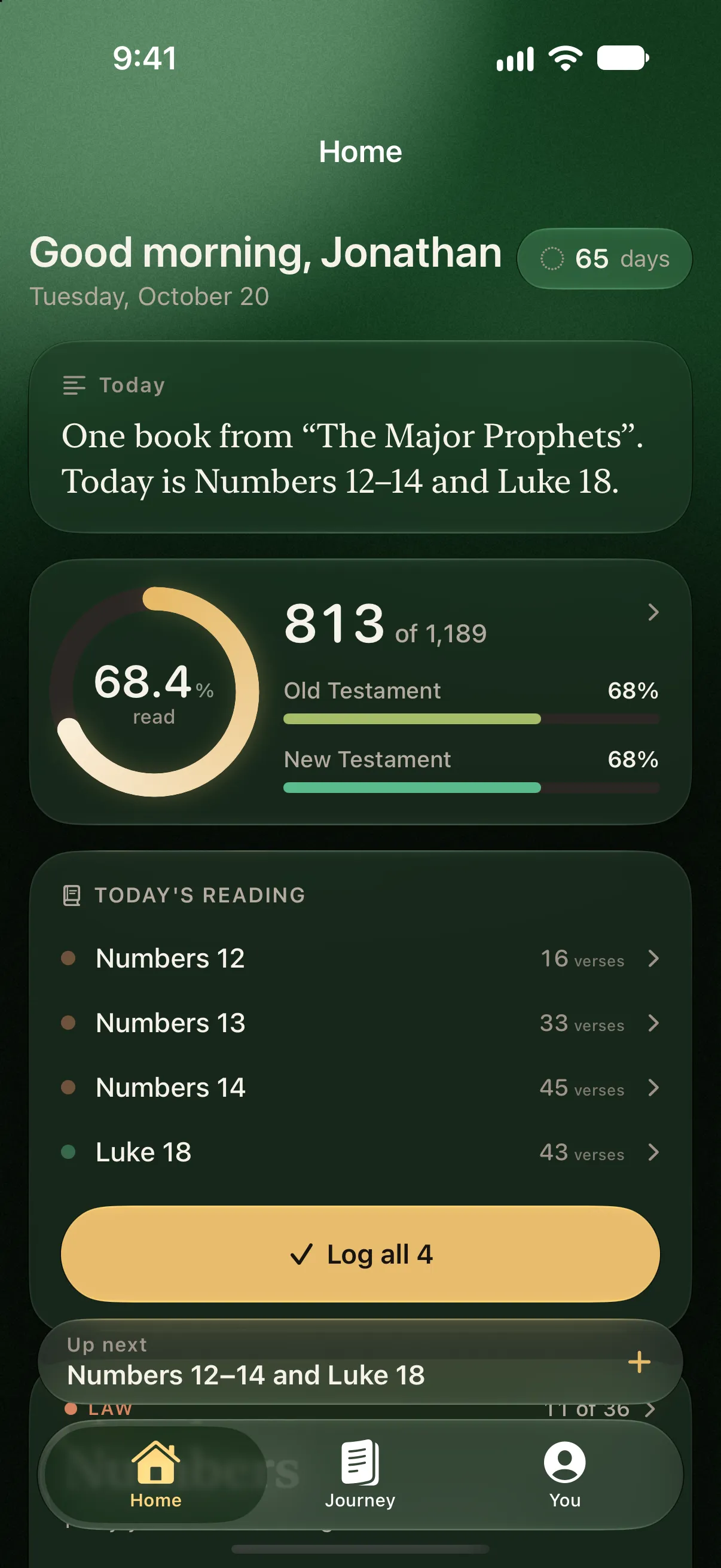
How to read the Bible every day (and survive a bad week)
How to read the Bible every day: how much to read, when to read it, what to do after a missed day, and what habit research says about making it stick.


The short answer
To read the Bible every day, choose an amount small enough for a busy day (one chapter takes about three minutes), tie it to something you already do daily, and decide what to read before the day starts. Expect missed days, and after one, read that day's portion rather than doubling up. In a widely cited study of habit formation, missing a single day made no real difference, and new habits took anywhere from 18 to 254 days to become close to automatic.
In this guide
- How to read the Bible every day, in five steps
- How much to read each day
- Tie it to something you already do
- Decide what to read before the day starts
- Plan for the bad week before it comes
- Count chapters, not unbroken days
- How many Christians read the Bible every day?
- Do you have to read the Bible every day?
- Questions people ask
- Sources
Most advice on how to read the Bible every day is a list of tips: pick a time, start small, use a plan. The tips are not wrong, but they rarely say how small, or what to do on the day the plan falls apart. Research on how habits form has useful things to say about both, and so do the numbers. A daily reading habit is less about willpower than about a portion you can keep and a plan that expects the bad week.
- 3 minto read an average chapter at a relaxed pace
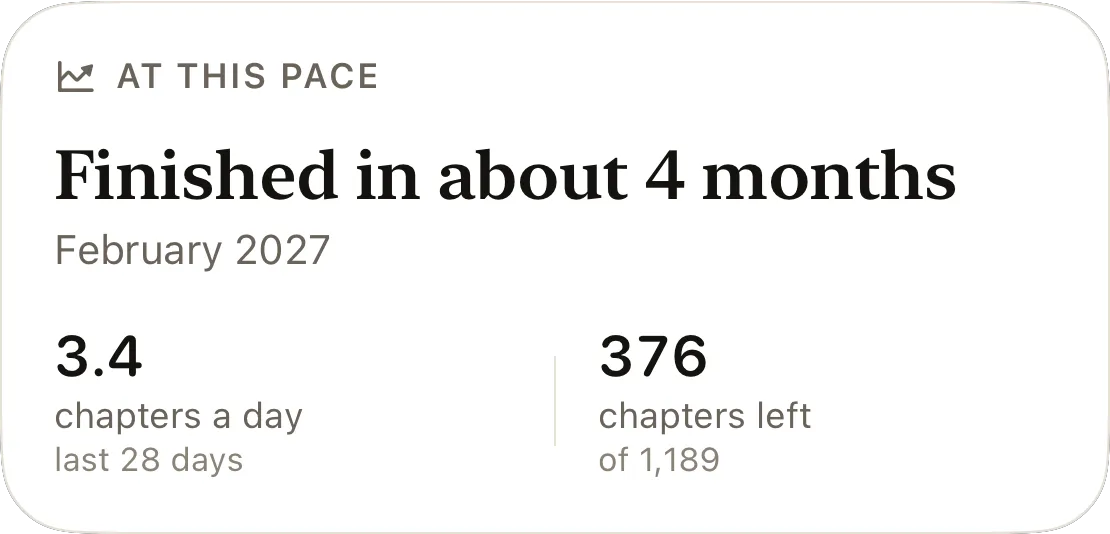
- 1,189 daysfor the whole Bible at a chapter a day
- 13 monthsfor the whole Bible at ten minutes a day
- 31 daysfor Proverbs, one chapter a day
How to read the Bible every day, in five steps
Reading the Bible every day comes down to five decisions, each made once rather than every morning:
- Choose an amount you could keep on a busy day. One chapter takes about three minutes. Start there, or at five minutes, and add more only once the small amount is easy.
- Attach it to something you already do daily, in the same place: the first coffee, the train, lunch, the last thing before the light goes out.
- Decide what to read before the day starts. A plan, or simply one book read in order, means opening the Bible never begins with a choice.
- Plan for the bad week. Give yourself a couple of spare days, and after a missed day read today’s portion rather than two days’ worth.
- Keep a record of what you have read, chapter by chapter, rather than a chain of unbroken days.
How much to read each day
The right daily amount is the one you could still manage on your worst ordinary day. By our count of the World English Bible, an average chapter is 631 words: a little over two and a half minutes at the average adult silent reading speed of 238 words a minute, and a little over three minutes at a relaxed 200. Here is where a few daily amounts get you, at about 3.3 minutes a chapter:
| A day | Chapters | The whole Bible (1,189 chapters) | The New Testament (260 chapters) |
|---|---|---|---|
| About 3 minutes | 1 | 1,189 days, about 3 years 3 months | 260 days, about 8½ months |
| 5 minutes | 1.5 | about 26 months | about 5½ months |
| 10 minutes | 3 | about 13 months | about 3 months |
| 15 minutes | 4.5 | about 8½ months | about 2 months |
| 20 minutes | 6 | about 6½ months | about 6 weeks |
Ten minutes a day reads the 66-book Protestant Bible in a little over a year, and one chapter a day still reads all of it. Shorter books make good first goals: Mark’s Gospel is 16 chapters, Philippians 4, and Proverbs has 31, one for each day of a long month. Our guide to how many minutes a day to read the Bible compares the 5, 10 and 15-minute habits in more detail.
Tie it to something you already do
A daily habit grows out of doing the same thing in the same setting, so the practical way to make reading daily is to fix it to a cue that already happens every day. A widely cited 2010 study by Phillippa Lally and colleagues, in the European Journal of Social Psychology, was built on exactly that: ninety-six volunteers each chose an eating, drinking or activity behavior to do daily in the same context for twelve weeks, and for most of them it grew more automatic with repetition, quickly at first and then leveling off. The time it took to get close to that plateau ranged from 18 to 254 days. Lally has since given the average as 66 days, and she points out that “if you make a clear plan of when and where you will do something you are more likely to do it.”
For Bible reading, the cue is whatever already happens every day without effort:
- A drink: the first coffee or tea, with the Bible left beside the kettle.
- A commute: the bus or train, with the text on your phone or an audio Bible in your ears.
- A meal: breakfast or lunch, before or after.
- The end of the day: in bed, before the light goes out.
The range in that study is the encouraging part. Some habits settled in under three weeks and some took most of a year, so a habit that still feels effortful in week six is not a sign that it isn’t working.
Morning or night?
Neither is better in itself; the better time is the one most reliably yours. Morning reading happens before the day fills up, which suits people whose evenings get taken over. Evening reading suits people whose mornings belong to children, commutes or early shifts. If one slot keeps slipping, try the other for a few weeks before deciding the habit is the problem.
Decide what to read before the day starts
A plan’s main job is to remove the daily decision. Opening a Bible with no idea where to begin adds a choice to the moment you have least patience for, and turning pages looking for something suitable can take longer than the reading. Decide the passage the night before, or let a plan decide it for you.
The common ways through are:
| Approach | What it reads | Good for |
|---|---|---|
| Start to finish | Genesis through Revelation, in order | Seeing the whole story in sequence |
| Old and New together | Some of each testament most days | Keeping the long stretches of law and history from arriving all at once |
| In the order written | Roughly when each book was composed | Reading the books against their own history |
| One book at a time | A single book, then the next | A first habit, or a gentler pace |
If you are starting from nothing, one Gospel read a chapter a day makes a calm first few weeks. Our Bible reading plan for beginners suggests an order for the first books.
Plan for the bad week before it comes
The most reliable way through a bad week is to expect one and build room for it into the plan. A 2019 study by Marissa Sharif and Suzanne Shu, published in Organizational Behavior and Human Decision Processes, shows why. More than 270 students and staff took a month-long step challenge. Some had to reach their goal seven days a week, some five days a week, and some seven days a week with a few emergency skips in reserve (two a week, or eight for the month).
The groups with emergency skips reached their goals up to 40 percent more often. The difference showed most the day after a miss: the group with two skips a week met its goal on 55 percent of those days, against 37 percent for the group with no slack at all, and 44 percent for the group that simply had the easier five-day target. Walking is not reading, and the study did not test reading, but its lesson is easy to borrow: keeping the goal and allowing a little room worked better than either a rigid goal or a lower one.
In practice, that means:
- Give yourself spare days. Two a week to use when life intervenes, or a plan built on five reading days a week, like the 5-day Bible reading plan.
- Keep a minimum version. On the worst days, one psalm counts. Psalm 23 is six verses and Psalm 117 is two.
- Change the format, not the habit. Listening to a chapter on a walk or a commute keeps the thread when sitting down to read is out of reach.
What to do the day after you miss
Read today’s portion and carry on. In Lally’s study, missing a single day “did not materially affect the habit formation process,” so one missed day leaves the habit where it was. Doubling up works against you, because it makes the day after a miss the heaviest of the week, and the heaviest day is the easiest to put off again.
If you follow a dated plan, you can either let the missed reading go and pick up at today’s date, or slide the whole plan back a day. The first keeps your finish date and leaves a passage to come back to; the second reads everything in order and finishes a day later. Our guide to catching up on a Bible reading plan covers longer gaps.
Count chapters, not unbroken days
A record of what you have read survives a missed day; an unbroken streak does not. Research by Jackie Silverman and Alixandra Barasch, published in the Journal of Consumer Research in 2023, found that seeing an intact streak in a log made people more likely to keep going than seeing a broken one, and that the difference came from how the log showed the behavior rather than from the behavior itself. The effect was stronger when people blamed themselves for the break, and weaker when a broken streak could be repaired.
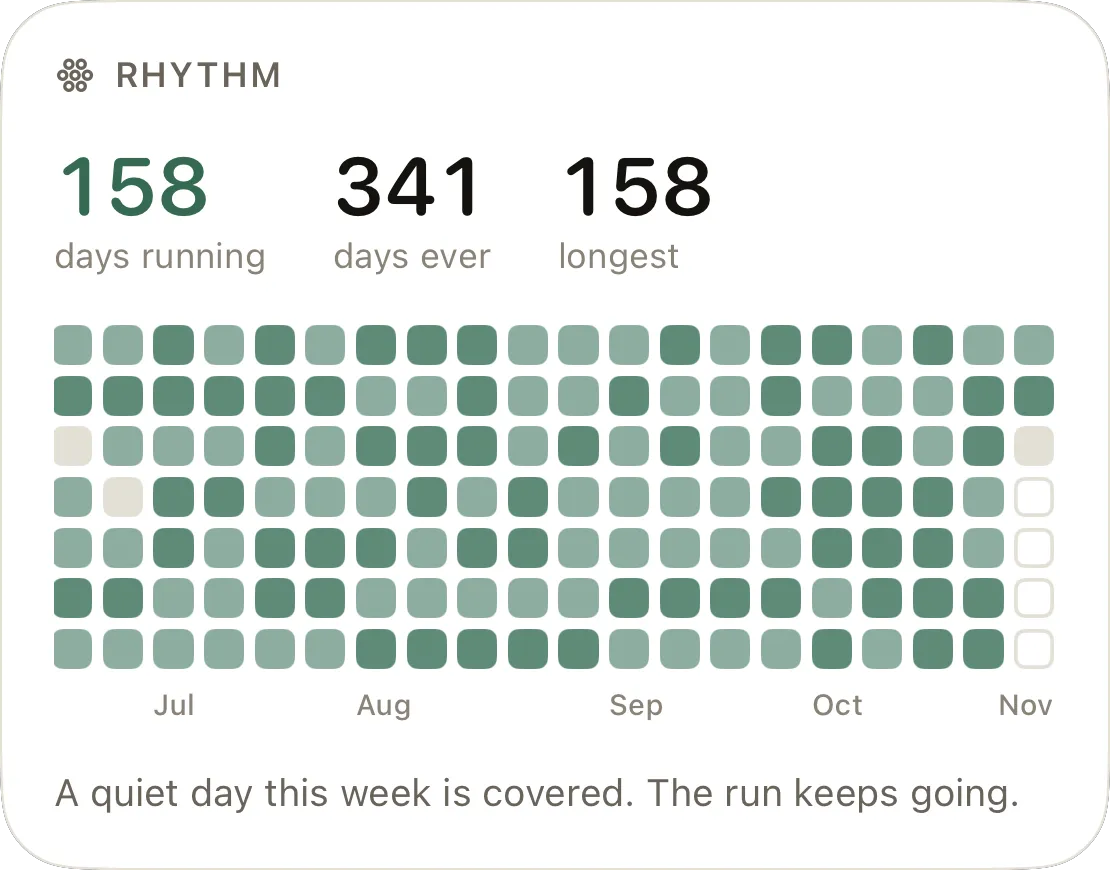
So a streak helps while it holds and can work against you the day it breaks, especially if the break feels like your fault. A record of chapters read, books finished and how much of the Bible you have covered only ever grows, and a missed day leaves it exactly where it was. If you do like a streak, one that forgives a quiet day is easier to live with; our guide to Bible reading streaks weighs both sides.
How many Christians read the Bible every day?
Fewer than a third of American Protestant churchgoers read the Bible every day, and about as many read it a few times a week. In a Lifeway Research survey of 2,130 American Protestant churchgoers who attend at least once a month, conducted in March 2025 and published in February 2026, 31 percent said they read every day, 30 percent a few times a week, 14 percent once a week, and the rest less often.
The daily figure has nearly doubled since 2007, when it was 16 percent; in 2012 it was 19. Lifeway adds that the churchgoing population itself has changed over that time. Even among regular churchgoers, most do not read every day, and reading a few times a week is about as common as reading daily. Our guide to how often Christians read the Bible has the full breakdown and the other surveys.
Do you have to read the Bible every day?
No verse sets a number of chapters a day, and different Christian traditions describe the place of personal Scripture reading in their own ways. The verses that speak of daily reading describe steady attention rather than an amount: Psalm 1 says of the person whose delight is in the law, “On his law he meditates day and night” (Psalm 1:2), and Acts commends the Bereans for “examining the Scriptures daily to see whether these things were so” (Acts 17:11, both in the World English Bible). In the Catholic Church, the Second Vatican Council’s Dei Verbum (1965) urges all the Christian faithful to frequent reading of the Scriptures, and quotes St. Jerome: “ignorance of the Scriptures is ignorance of Christ.”
Whether a day without reading is a sin is a question for your own tradition, and a pastor or priest who knows you is a better guide to it than any article. What can be said plainly is practical. The Protestant Bible is about 52 hours of silent reading at an average adult pace, so a small daily portion is how it fits into an ordinary life, and three minutes a day reads all of it in a little over three years.
A chapter read the morning after a missed week counts exactly as much as the one you read on the first day.
Questions people ask
How long does it take to build a Bible reading habit?
There is no fixed number. In Phillippa Lally's 2010 study of daily habits, the time it took a behavior to become close to automatic ranged from 18 to 254 days, with an average of 66. The behaviors were eating, drinking and physical activity rather than reading, and a single missed day did not set the process back.
Is it better to read the Bible in the morning or at night?
Neither is better in itself. What matters most is a slot you can keep on ordinary days, tied to something you already do. Mornings suit people whose evenings get taken over; evenings suit people whose mornings belong to children, commutes or early shifts. If one time keeps slipping, moving to the other is a fair experiment.
How many chapters of the Bible should I read a day?
As many as you could manage on a busy day. One chapter takes about three minutes and covers the 66-book Protestant Bible in 1,189 days, about three years and three months. Three chapters a day, around ten minutes, takes a little over a year. Proverbs, at 31 chapters, is a month at one a day.
Is it a sin not to read the Bible every day?
No verse sets a number of chapters a day, and Christian traditions describe the place of Scripture reading in their own ways. The Catholic Church's Dei Verbum urges all the faithful to frequent reading of Scripture. A pastor or priest in your own tradition is the right person to ask, and a missed day can simply be followed by reading the next one.
How can I stay consistent reading the Bible when I'm busy?
Make the daily amount smaller rather than skipping, and keep a minimum version for the worst days, such as one psalm. Read at the same point in a routine you already keep, decide the passage the night before, and allow a couple of spare days a week. Listening to an audio Bible on a commute also counts.
Sources
- Lally, P., van Jaarsveld, C. H. M., Potts, H. W. W. and Wardle, J. (2010). How are habits formed: Modelling habit formation in the real world. European Journal of Social Psychology, 40(6), 998–1009.
- Does it really take 66 days to form a habit? We asked expert Dr Pippa Lally, University of Surrey (21 January 2026)
- The Case for Building Wiggle Room into Goals, UCLA Anderson Review (on Sharif and Shu, Nudging persistence after failure through emergency reserves, Organizational Behavior and Human Decision Processes, 2019)
- On or Off Track: How (Broken) Streaks Affect Consumer Decisions, University of Colorado Boulder (Silverman and Barasch, Journal of Consumer Research, 2023)
- Lifeway Research finds fewer than 1 in 3 churchgoers read the Bible daily, Lifeway Research (10 February 2026)
- Dogmatic Constitution on Divine Revelation (Dei Verbum), 1965, vatican.va
- Brysbaert, M. (2019). How many words do we read per minute? A review and meta-analysis of reading rate. Journal of Memory and Language, 109, 104047.
- World English Bible, verse-per-line edition (public domain), eBible.org
- King James Version, verse-per-line edition (public domain), eBible.org