The books of the Bible in order, with chapter counts
All 66 books of the Bible in order with their chapters, the 73-book Catholic order, how Orthodox, Ethiopian and Hebrew Bibles differ, and a free printable list.

The short answer
The Protestant Bible has 66 books and 1,189 chapters. The Old Testament's 39 run from Genesis to Malachi: five books of Law (Genesis to Deuteronomy), twelve of History (Joshua to Esther), five of Wisdom (Job to Song of Songs) and seventeen of Prophets (Isaiah to Malachi). The New Testament's 27 run from Matthew to Revelation: four Gospels, Acts, Paul's thirteen letters (Romans to Philemon), Hebrews and seven general letters, then Revelation. A Catholic Bible has 73 books, with seven more in the Old Testament.
In this guide
- The books of the Bible in order
- Old Testament books in order
- New Testament books in order
- Catholic books of the Bible in order
- Orthodox, Ethiopian and Hebrew Bibles in order
- Why are the books of the Bible in this order?
- How to memorize the books of the Bible
- A printable list of the books of the Bible
- Questions people ask
- Sources
Ask for the books of the Bible in order and the answer depends on whose Bible you hold. Most English Bibles have 66 books in a fixed order, but Catholic, Orthodox and Ethiopian Bibles carry more, and the Jewish Bible arranges the same Old Testament books differently.
- 66books in the Protestant Bible
- 39in the Old Testament, Genesis to Malachi
- 27in the New Testament, Matthew to Revelation
- 73books in a Catholic Bible
The books of the Bible in order
The 66 books of the Protestant Bible run from Genesis, book 1, to Revelation, book 66: Malachi closes the Old Testament as book 39, and Matthew opens the New as book 40. The King James Version and modern translations such as the World English Bible print them in exactly this order. Here is every book with its chapters, the division it belongs to, and the one line it is best known for.
| Book | Chapters | Division | What it’s known for |
|---|---|---|---|
| Old Testament | |||
| Genesis | 50 | Law | Creation, the flood, and the promise to Abraham |
| Exodus | 40 | Law | The burning bush, the plagues, the sea parting |
| Leviticus | 27 | Law | How a holy people is meant to live |
| Numbers | 36 | Law | Forty years of wandering in the wilderness |
| Deuteronomy | 34 | Law | Moses' last words on the edge of the land |
| Joshua | 24 | History | The walls of Jericho |
| Judges | 21 | History | Deborah, Gideon and Samson |
| Ruth | 4 | History | A widow's loyalty, four chapters long |
| 1 Samuel | 31 | History | David and Goliath |
| 2 Samuel | 24 | History | David's reign, and his worst night |
| 1 Kings | 22 | History | Solomon's temple; Elijah on Carmel |
| 2 Kings | 25 | History | Two kingdoms fall |
| 1 Chronicles | 29 | History | The genealogies, then David |
| 2 Chronicles | 36 | History | The temple, from build to burning |
| Ezra | 10 | History | Coming home from exile |
| Nehemiah | 13 | History | Rebuilding the wall in fifty-two days |
| Esther | 10 | History | “For such a time as this” |
| Job | 42 | Wisdom | The oldest argument about suffering |
| Psalms | 150 | Wisdom | Everything a person can say to God |
| Proverbs | 31 | Wisdom | One chapter for every day of the month |
| Ecclesiastes | 12 | Wisdom | “Everything is vapor” |
| Song of Songs | 8 | Wisdom | A love poem, unembarrassed |
| Isaiah | 66 | Prophets | “Comfort, comfort my people” |
| Jeremiah | 52 | Prophets | The prophet who kept crying |
| Lamentations | 5 | Prophets | Five poems over a ruined city |
| Ezekiel | 48 | Prophets | Wheels of fire and a valley of dry bones |
| Daniel | 12 | Prophets | The lions' den and the fiery furnace |
| Hosea | 14 | Prophets | A marriage as a message |
| Joel | 3 | Prophets | Locusts, and the promise of the Spirit |
| Amos | 9 | Prophets | “Let justice roll down like waters” |
| Obadiah | 1 | Prophets | The shortest book in the Old Testament |
| Jonah | 4 | Prophets | The prophet who ran the other way |
| Micah | 7 | Prophets | “Act justly, love mercy, walk humbly” |
| Nahum | 3 | Prophets | Nineveh's second act |
| Habakkuk | 3 | Prophets | A prophet who argues, and is answered |
| Zephaniah | 3 | Prophets | The day of the Lord, in three chapters |
| Haggai | 2 | Prophets | Two chapters, one job: rebuild |
| Zechariah | 14 | Prophets | Eight strange night visions |
| Malachi | 4 | Prophets | The last word before four silent centuries |
| New Testament | |||
| Matthew | 28 | Gospels | The Sermon on the Mount |
| Mark | 16 | Gospels | The fastest gospel — everything happens 'immediately' |
| Luke | 24 | Gospels | The prodigal son and the good Samaritan |
| John | 21 | Gospels | “In the beginning was the Word” |
| Acts | 28 | Acts | Pentecost, and the road to Rome |
| Romans | 16 | Epistles | Paul's most systematic letter |
| 1 Corinthians | 16 | Epistles | Chapter 13, read at every wedding |
| 2 Corinthians | 13 | Epistles | Paul at his most personal |
| Galatians | 6 | Epistles | Freedom, argued urgently |
| Ephesians | 6 | Epistles | The armor of God |
| Philippians | 4 | Epistles | A joyful letter written from prison |
| Colossians | 4 | Epistles | Christ over everything |
| 1 Thessalonians | 5 | Epistles | Probably the earliest letter we have |
| 2 Thessalonians | 3 | Epistles | On waiting well |
| 1 Timothy | 6 | Epistles | Letters to a younger colleague |
| 2 Timothy | 4 | Epistles | “I have finished the race” |
| Titus | 3 | Epistles | Three chapters on ordinary integrity |
| Philemon | 1 | Epistles | One chapter about one runaway slave |
| Hebrews | 13 | Epistles | Chapter 11's roll call of faith |
| James | 5 | Epistles | Blunt, practical, five chapters |
| 1 Peter | 5 | Epistles | Written to people under pressure |
| 2 Peter | 3 | Epistles | A warning, and a long view of time |
| 1 John | 5 | Epistles | “God is love” |
| 2 John | 1 | Epistles | Thirteen verses on a postcard |
| 3 John | 1 | Epistles | The shortest book in the Bible |
| Jude | 1 | Epistles | One fierce chapter |
| Revelation | 22 | Revelation | Seven letters, seven seals, a new city |
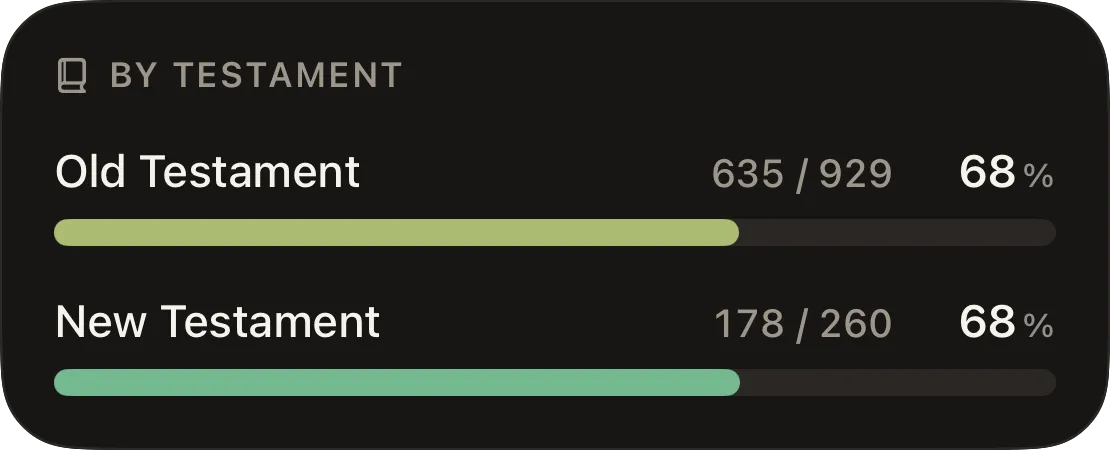
Together they come to 1,189 chapters: 929 in the Old Testament and 260 in the New. Our guide to how many chapters are in the Bible gives each book’s count in every canon.
Old Testament books in order
The 39 books of the Old Testament run from Genesis to Malachi in four groups:
- Law (5 books, 187 chapters): Genesis, Exodus, Leviticus, Numbers, Deuteronomy. These five are also called the Pentateuch, or in Jewish tradition the Torah.
- History (12 books, 249 chapters): Joshua, Judges, Ruth, 1 Samuel, 2 Samuel, 1 Kings, 2 Kings, 1 Chronicles, 2 Chronicles, Ezra, Nehemiah, Esther.
- Wisdom and poetry (5 books, 243 chapters): Job, Psalms, Proverbs, Ecclesiastes, Song of Songs (also called the Song of Solomon).
- Prophets (17 books, 250 chapters): first the five books known as the Major Prophets (Isaiah, Jeremiah, Lamentations, Ezekiel, Daniel), then the twelve short ones known as the Minor Prophets (Hosea, Joel, Amos, Obadiah, Jonah, Micah, Nahum, Habakkuk, Zephaniah, Haggai, Zechariah, Malachi).
The twelve Minor Prophets have 67 chapters between them, one more than Isaiah alone. The Psalms hold 150 of Wisdom’s 243.
New Testament books in order
The 27 books of the New Testament run from Matthew to Revelation, in the same order in English Protestant and Catholic Bibles alike:
- Gospels (4 books, 89 chapters): Matthew, Mark, Luke, John.
- Acts (1 book, 28 chapters): the Acts of the Apostles, which carries the story on from the Gospels.
- Paul’s letters (13 books, 87 chapters): Romans, 1 Corinthians, 2 Corinthians, Galatians, Ephesians, Philippians, Colossians, 1 Thessalonians, 2 Thessalonians, 1 Timothy, 2 Timothy, Titus, Philemon.
- Hebrews and the general letters (8 books, 34 chapters): Hebrews, James, 1 Peter, 2 Peter, 1 John, 2 John, 3 John, Jude.
- Revelation (1 book, 22 chapters): the Book of Revelation, the last book of the New Testament.
Four of the Protestant Bible’s five one-chapter books are in this list: Philemon, 2 John, 3 John and Jude. The fifth, Obadiah, is a Minor Prophet.
Catholic books of the Bible in order
A Catholic Bible has 73 books: the same 27 in the New Testament and 46 in the Old. The seven books Protestant Bibles do not carry sit among the others by kind: Tobit, Judith and 1 and 2 Maccabees with the histories, Wisdom and Sirach with the wisdom books, and Baruch after Lamentations. This is the Old Testament of the New American Bible, in the order the Vatican publishes it:
| Book | Chapters |
|---|---|
| Genesis | 50 |
| Exodus | 40 |
| Leviticus | 27 |
| Numbers | 36 |
| Deuteronomy | 34 |
| Joshua | 24 |
| Judges | 21 |
| Ruth | 4 |
| 1 Samuel | 31 |
| 2 Samuel | 24 |
| 1 Kings | 22 |
| 2 Kings | 25 |
| 1 Chronicles | 29 |
| 2 Chronicles | 36 |
| Ezra | 10 |
| Nehemiah | 13 |
| Tobit | 14 |
| Judith | 16 |
| Esther | 16 |
| 1 Maccabees | 16 |
| 2 Maccabees | 15 |
| Job | 42 |
| Psalms | 150 |
| Proverbs | 31 |
| Ecclesiastes | 12 |
| Song of Songs | 8 |
| Wisdom | 19 |
| Sirach | 51 |
| Isaiah | 66 |
| Jeremiah | 52 |
| Lamentations | 5 |
| Baruch | 6 |
| Ezekiel | 48 |
| Daniel | 14 |
| Hosea | 14 |
| Joel | 3 |
| Amos | 9 |
| Obadiah | 1 |
| Jonah | 4 |
| Micah | 7 |
| Nahum | 3 |
| Habakkuk | 3 |
| Zephaniah | 3 |
| Haggai | 2 |
| Zechariah | 14 |
| Malachi | 4 |
Two books are also longer. Esther is read with six Greek additions, which the New American Bible marks with the letters A to F among its ten numbered chapters; counted the way the Latin Vulgate numbers them, as here, Esther has 16 chapters. Daniel has 14, with Susanna as chapter 13 and Bel and the Dragon as chapter 14, again as the Vulgate numbers them. Catholics call the seven books deuterocanonical, and Protestants have usually called them the Apocrypha; the guide to the Catholic and Protestant Bibles explains how the two lists came to differ.
Books of the Bible in order with the Apocrypha
Some Protestant Bibles print the Apocrypha too, in a section of its own. The King James Version of 1611 had 80 books: the 39 of the Old Testament, 14 of the Apocrypha and the 27 of the New. Like Luther’s German Bible, it set these books between the testaments, under the heading “the Books called Apocrypha”. The fourteen were 1 and 2 Esdras, Tobit, Judith, the Rest of Esther, the Wisdom of Solomon, Ecclesiasticus (Sirach), Baruch with the Epistle of Jeremiah, the three additions to Daniel (the Song of the Three Children, Susanna, and Bel and the Dragon), the Prayer of Manasses, and 1 and 2 Maccabees.
The Anglican Thirty-Nine Articles say the church reads these books “for example of life and instruction of manners” but does not use them to establish doctrine. Most later printings of the King James Version left them out.
Orthodox, Ethiopian and Hebrew Bibles in order
Orthodox, Ethiopian and Jewish Bibles order their Old Testament books differently from Western Christian Bibles, and in places name them differently too. Orthodox and Ethiopian Bibles both carry the New Testament’s 27 books; the differences below are in the Old.
Orthodox Bibles
Orthodox Bibles use different names for some books, and a different order. In the list OrthodoxWiki gives:
- 1 and 2 Samuel and 1 and 2 Kings are 1 to 4 Kingdoms, numbered as one series.
- 1 Esdras sits among the histories, and Tobit, Judith, Esther with its additions and 1, 2 and 3 Maccabees follow Nehemiah.
- Psalms comes before Job, then Proverbs, Ecclesiastes, the Song of Solomon, the Wisdom of Solomon and Sirach.
- The twelve Minor Prophets come before Isaiah, in a slightly different order (Hosea, Amos, Micah, Joel, Obadiah, Jonah, then Nahum to Malachi), so the Old Testament ends with Ezekiel and Daniel.
- The Letter of Jeremiah is a book of its own, and 4 Maccabees usually sits in an appendix with the Prayer of Manasseh.
Orthodox churches do not all print the same list; 4 Maccabees, for one, is often set apart or left out. The guide to the Orthodox Bible sets out which books each tradition includes.
The Ethiopian Bible
The Ethiopian Orthodox Tewahedo Church has the largest canon in traditional Christianity, usually counted as 81 books, and its own order. In its Old Testament, Jubilees and Enoch come straight after 2 Chronicles, the three books of Meqabyan follow Esther, and Proverbs is counted as two books. The Meqabyan are different books from 1 and 2 Maccabees, which the Ethiopian canon does not include. The Ethiopian Bible has its own guide.
The Hebrew Bible
The Jewish Bible, the Tanakh, has the same books as the Protestant Old Testament, counted as 24 and arranged in three parts: the Torah (Genesis to Deuteronomy), the Nevi’im or Prophets, and the Ketuvim or Writings. The name Tanakh is made from the first letters of the three.
The Prophets begin with Joshua, Judges, Samuel and Kings, then Isaiah, Jeremiah, Ezekiel and the Twelve, counted as one book. The Writings hold the rest: Psalms, Proverbs and Job, the five scrolls (Song of Songs, Ruth, Lamentations, Ecclesiastes and Esther), then Daniel, Ezra–Nehemiah and, in most printed editions, Chronicles. Counting Samuel, Kings, Chronicles, Ezra–Nehemiah and the Twelve as one book each is what turns 39 into 24. So Ruth, Esther and Daniel sit in different places, and the Hebrew Bible ends with Chronicles rather than Malachi.
Why are the books of the Bible in this order?
The books are grouped by the kind of writing they are, not by when they were written. Gregory Goswell, writing for Crossway, notes that the Hebrew and Greek traditions “basically have the same books but not the same order”, and that “the modern Bible follows the pattern laid down by the early Greek Old Testament (Septuagint)”: law, history, poetry and wisdom, and the prophets last. For the New Testament, he writes, “the factor of genre dominates”: Gospels, then Acts, then the letters, then Revelation.
Goswell also reads something in the endings. With the prophets placed last, the Christian Old Testament closes on prophecy, and the New Testament follows to tell of its fulfillment. The Hebrew Bible closes with Chronicles instead, an ending he reads as looking ahead too, to the coming of God’s kingdom. He treats both orders as the work of the people who read the Bible before us: “These choices by earlier readers have shaped the very form of the Bible that we have inherited from their hands.”
Paul’s letters run from longest to shortest
Paul’s thirteen letters follow a rule of their own: length. They come in two sets, letters to churches and then letters to individuals, and each set runs from longest to shortest. By our count of the World English Bible, the nine letters to churches step down from Romans at 9,434 words to 2 Thessalonians at 1,036 without a single step up, and the four to individuals do the same, from 1 Timothy (2,269) to Philemon (445).
| Book | Chapters | Words |
|---|---|---|
| Romans | 16 | 9,434 |
| 1 Corinthians | 16 | 9,353 |
| 2 Corinthians | 13 | 6,080 |
| Galatians | 6 | 3,121 |
| Ephesians | 6 | 3,084 |
| Philippians | 4 | 2,219 |
| Colossians | 4 | 1,990 |
| 1 Thessalonians | 5 | 1,836 |
| 2 Thessalonians | 3 | 1,036 |
| 1 Timothy | 6 | 2,269 |
| 2 Timothy | 4 | 1,613 |
| Titus | 3 | 904 |
| Philemon | 1 | 445 |
Words are our own count of the World English Bible, a public-domain modern translation.
In the Greek the pattern has one exception: Galatians comes before Ephesians, which is slightly longer. Hebrews, at 6,876 words in the same count, is longer than every letter of Paul’s except Romans and 1 Corinthians, yet it comes after Philemon. It names no author, and placing it at the end of Paul’s letters was popularized by Jerome’s Latin Vulgate in the 4th century; Jerome knew of the old doubts about who wrote it.
Is the Bible in chronological order?
No, and the clearest sign is the prophets. Isaiah opens by dating itself “in the days of Uzziah, Jotham, Ahaz, and Hezekiah, kings of Judah” (Isaiah 1:1, World English Bible), reigns that 2 Kings has already told, and Isaiah himself appears in 2 Kings 20 at Hezekiah’s sickbed, eleven books before his own in the Protestant order. In the New Testament, 1 Thessalonians, which most scholars date to about 49 to 51 AD, is one of the first books written, but sorted by length among Paul’s letters, it stands 52nd of the 66.
If you want the books in the order they were composed instead, the guide to the books of the Bible in the order they were written lists them that way, with the dates scholars give.
How to memorize the books of the Bible
Memorize the groups first, and the 66 names become a handful of short runs. The grouping below is the Protestant one, as used above:
- Old Testament: 5, 12, 5, 5, 12. Law, History, Wisdom, the five Major Prophets, the twelve Minor Prophets.
- New Testament: 4, 1, 13, 8, 1. Gospels, Acts, Paul, Hebrews with the general letters, Revelation.
- Anchor each group by its first and last book: Genesis to Deuteronomy, Joshua to Esther, Job to Song of Songs, Isaiah to Daniel, Hosea to Malachi; Matthew to John, Romans to Philemon, Hebrews to Jude.
- Let the numbered books carry each other. 1 and 2 Samuel, Kings and Chronicles come in a row, as do 1 and 2 Corinthians, Thessalonians, Timothy and Peter, and 1, 2 and 3 John.
- Split the Minor Prophets into threes: Hosea, Joel, Amos; Obadiah, Jonah, Micah; Nahum, Habakkuk, Zephaniah; Haggai, Zechariah, Malachi.
- Use the length rule for Paul. Churches first, longest to shortest; then people. For Galatians, Ephesians, Philippians and Colossians, a phrase made from the initials G, E, P, C helps.
Singing the groups to any tune you know works the same way, and so does saying one group a day until it comes without thinking. To test yourself, write the names on a blank page and check them against the list.
A printable list of the books of the Bible
The books of the Bible checklist puts every book on one page, by testament and division, with its chapter count and a box to tick when you have read it. There is a Started and Finished line at the foot.
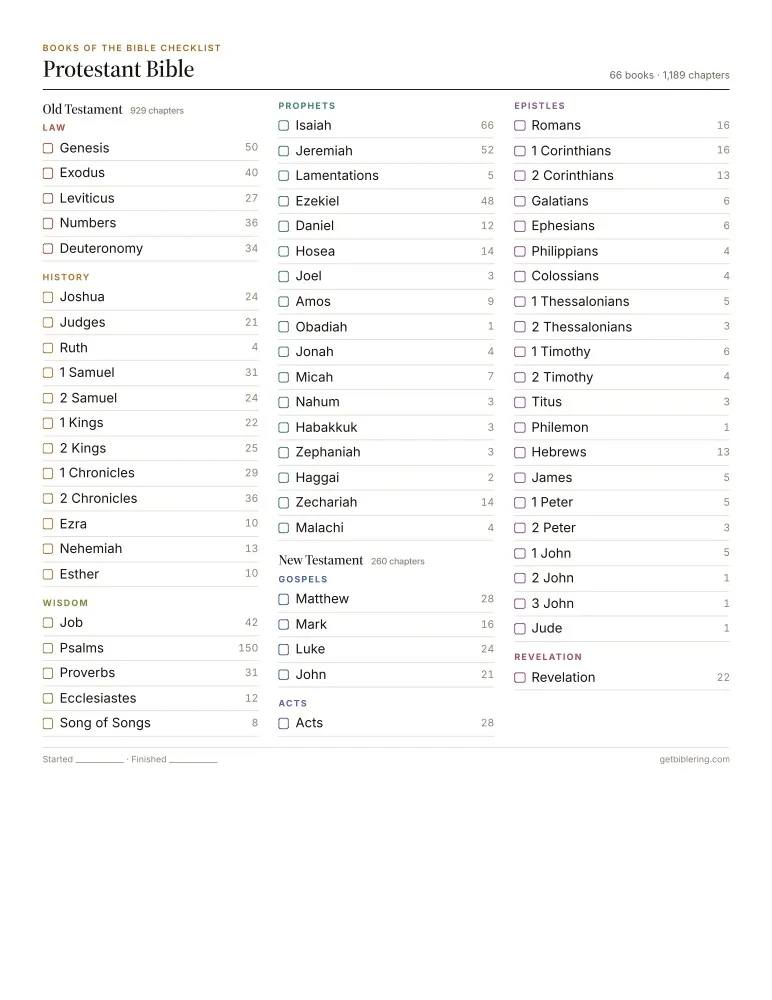
The same checklist exists for a Bible with the Apocrypha (Letter, A4), the Orthodox Bible (Letter, A4) and the Ethiopian Bible (Letter, A4). Those three set the books each canon carries beyond the 66 among them by kind of writing, so they are lists to tick rather than any one church’s printed order. For a box for every chapter instead of every book, the printable Bible reading tracker has one for each canon.
Questions people ask
What is the first and last book of the Bible?
Genesis is the first book in every Bible, Jewish and Christian, and the New Testament ends with Revelation. The Old Testament ends with Malachi in Protestant and Catholic Bibles, and with Daniel in many Orthodox Bibles, which put the twelve Minor Prophets before Isaiah. The Hebrew Bible, in most printed editions, ends with Chronicles.
Who put the books of the Bible in order?
No single person. The order grew out of the choices of earlier readers who copied, translated and arranged the books over centuries. The Christian Old Testament follows the pattern of the early Greek translation, the Septuagint, and some details were spread by later editions. Placing Hebrews at the end of Paul's letters, for one, was popularized by Jerome's Latin Vulgate in the 4th century.
Is the Bible in chronological order?
No. The books are grouped by kind of writing rather than by date. The prophets come as one block after the history books, though many of them lived through the events those books tell, and Paul's letters are sorted by length. 1 Thessalonians, one of the first New Testament books written, is the 52nd of the Protestant Bible's 66 books.
What order are the books in a Catholic Bible?
A Catholic Bible has 73 books, and its New Testament is the same 27 books in the same order. The 46-book Old Testament places Tobit, Judith, Esther and 1 and 2 Maccabees after Nehemiah, Wisdom and Sirach after the Song of Songs, and Baruch after Lamentations. Esther and Daniel are longer, with their Greek additions.
What is the easiest way to memorize the books of the Bible?
Learn the groups before the names. The Old Testament is 5, 12, 5, 5 and 12 (Law, History, Wisdom, the Major Prophets, the Minor Prophets) and the New Testament 4, 1, 13, 8 and 1. Then learn the first and last book of each group, and fill in the middle one group at a time.
Sources
- New American Bible, contents, The Holy See
- Gregory Goswell, Why Are the Books of the Bible in the Order They're In?, Crossway (March 25, 2023)
- Pauline epistles, Wikipedia
- First Epistle to the Thessalonians, Wikipedia
- Esther, introduction, New American Bible Revised Edition (USCCB)
- Additions to Daniel, Wikipedia
- King James Version, Wikipedia
- Biblical apocrypha, Wikipedia
- Old Testament Canon, OrthodoxWiki
- Orthodox Tewahedo biblical canon, Wikipedia
- Hebrew Bible, Wikipedia
- Ketuvim, Wikipedia
- Five Megillot, Wikipedia
- World English Bible, verse-per-line edition (public domain), eBible.org
- King James Version, verse-per-line edition (public domain), eBible.org